Itineraries 2008
From the editor…
The six articles in this issue of Itineraries describe creative approaches to addressing the challenge and expanding older adult engagement with meaningful work.
- “The Life Planning Network” is a new community of professionals who provide a broad spectrum of life planning services and resources for the Third Age. Meg Newhouse is the founder of the New England-based network, an experienced career counselor, and co-author of Life Planning for the Third Age: A Design and Resource Guide and Toolkit.
- “The InternShop” provides opportunities for midlife interns to try out vocations that fit their skills and passions through paid or unpaid internships. Its founder, Julie Lopp, is an entrepreneur and a faculty member at the Fairchild Institute in Santa Barbara, CA.
- In “Making a Public Difference,” Jim Scheibel, former mayor of St. Paul, MN, and the director of VISTA and the Senior Corps during the Clinton Administration, argues that the best work of one’s life may likely be in one’s future. The opportunity to give back, to be involved with an issue about which one is passionate, and to leave a legacy can be filled through service.
- “Opening Doors for Encore Careers” describes the challenge taken on by Civic Ventures to inspire non-profit employers to tap the talent pool of Older Americans. Phyllis Segal, Vice President of Civic Ventures, is directing this effort from Boston, MA.
- “The Aging Adventurer” has published a resource guide to help older adults find ways to follow their hearts. Emily Kimball, founder of Make It Happen!, shows how volunteering, education, and travel adventure qualify as meaningful work.
- “Work in the Third Age of Life” tells a story about the nature of right livelihood, to encourage those in the Third Age to do everything with more attentiveness, gratitude, and joy. Now based in North Carolina, John Sullivan is Powell Professor Emeritus at Elon University.
- Finally, Barbara Kammerlohr, Second Journey’s Book Page editor, reviews three books that complement the articles and show how meaningful work exercises all of the dimensions of wellness: physical, mental, social, emotional, vocational, and spiritual.
We’ve embellished the issue with two especially relevant poems — “The Seven Seeds of Meaningful Work” by Dave Smith and “To Be of Use” by Marge Piercy. At the start of most articles, you will also find a brief excerpt from David Whyte’s wonderful book on work, Crossing the Unknown Sea: Work as a Pilgrimage of Identity. Its rare mix of poetry, stories from the workplace front (like the one below), Whyte’s own unusual take on the industrial revolution, and his account of his personal search for meaning through work will delight you.
Why is meaningful work — paid or unpaid — through the last breath so important?
Read on . . .
— Janet Hively
//
The Seven Seeds of Meaningful Work
By Dave Smith
Meaningful work comes alive
With faith in others as well as ourselves.
And that requires Hope…
Meaningful work comes alive
When hope engenders positive change,
And that requires Justice…
Meaningful work comes alive
When justice acts from care and compassion.
And that requires Temperance…
Meaningful work comes alive
When temperance moderates thoughtless greed.
And that requires Prudence…
Meaningful work comes alive
With the prudence of a creative democracy.
And that requires Courage…
Meaningful work comes alive
When purposeful courage fits community needs.
And that requires Love…
Meaningful work comes alive
With love of others as well as ourselves.
And that requires You and Me.
from To Be of Use (2005)
Life Planning for the Third Age by Meg Newhouse
Meg Newhouse is a nationally known pioneer in Third-Age LifeCrafting and an experienced group facilitator, teacher, coach, and program designer. As a catalyst for living with passion, purpose and grace after 50, she gives talks and workshops, writes, and consults to organizations, helping people create vital, fulfilling later lives that express who they are and how they want to contribute. She is currently working on a book on purposeful legacy. The founder of the Life Planning Network, she is the co-author of Life Planning for the Third Age: A Design Guide and Toolkit. Meg holds a BA from Wellesley College, MAT from Harvard University, and PhD in political science from UCLA. She is an avid learner/seeker on many fronts, a serious amateur flutist, and devoted friend, family member and grandmother. Visit her website at www.passionandpurpose.com.
“We must continually forge our identities through our endeavors.”
— David Whyte, Crossing the Unknown Sea: Work as a Pilgrimage of Identity
Imagine a large room filled to capacity and buzzing with excitement. About 140 participants from all over the US and as far away as Canada, France, Russia, and Switzerland have gathered for the first national conference on Life Planning for the Third Age (aka, the post-midlife “bonus years” of extended middle age and active elderhood). They are applauding Gene Cohen, the keynote speaker. Author of The Creative Age and The Mature Mind, he has just inspired the audience with his compelling, data-driven, delightfully illustrated case for positive psychological and neurological growth with — not despite — aging. And they are looking forward to the next day’s pre-conference, followed by two more days of life-planning offerings as part of the first National Positive Aging Conference, held in December at Eckerd College in St. Petersburg, Florida.
Why was this conference significant in the context of meaningful work on the Second Journey? And why should it excite a broader audience of third-agers and professionals?
Let me start with the bottom line and a bald assertion: We are on the cusp of a paradigm shift from a deficit model of aging and retirement to a model of continued growth, contribution, and possibility, which features meaningful work as an essential piece. Because the time is ripe and the need is clear, a national network is emerging to support diverse professionals working to establish an integrated approach to life planning for these 20–30 bonus years of (mostly) positive aging.
In this brief article I will outline the context that suggests the need for life planning, briefly describe The Life Planning Network, and recap the genesis and outcome of the recent conference.
The Context
Because of the longevity revolution of the last century, most of us can expect 20–30 “bonus years” of extended middle age and active elderhood, presenting opportunities as well as challenges. Because this involves a major transition to largely uncharted territory, many people need help in consciously creating a next phase of life that falls between their career-building years and eventual retirement. Answering questions such as “What will fulfill me?” and “How can I use my talents and gifts to serve others?” initiates a process of exploring choices among a wide array of life activities. This process includes but moves beyond financial planning and the newer need for later life career planning to include all dimensions of vital aging. As people become more engaged and fulfilled citizens during the “third age” of their lives, the ripple effects will gradually raise the value society places on this rich resource as well as on aging itself.
The Life Planning Network
Helping to catalyze this paradigm shift is the Life Planning Network (LPN), a small but vibrant New England-based community of professionals from diverse fields who share a commitment to providing a broad spectrum of life planning services and resources for the Third Age. Founded in 2002 and incorporated as a 501(c)6 since 2005, the LPN offers professional development, support, and opportunities to shape the burgeoning field of third-age life planning. It equips and mobilizes its members — working together and with strategic allies — to bring life planning into the mainstream and to advance the cause of self- and social renewal in the third age.
A small, values-driven organization of committed volunteers can accomplish a lot — including organizing a national conference — under nourishing conditions, including an inspiring mission/vision, a model of co-leadership and collaboration, and a value of learning and professionalism leading to valuable educational programs, study groups, and projects to increase our members’ knowledge and competencies. A commitment to diversity and a holistic framework has generated contributions from a range of professionals helping people intentionally design their later lives. In addition to life, career, and executive coaches, our members include financial and estate planners as well as housing, health, educational, and HR professionals, who refer to, collaborate with, and learn from each other.
The Conference
Two years ago LPN articulated a vision to hold a national conference to bring together others from diverse professions and locales to share and expand our knowledge, enhance our professionalism, and create ways to further conversations and collaboration. In the early planning stages we were fortunate to join a group of national leaders in the Positive Aging movement1 in planning for the first national Positive Aging conference. We were also blessed with a substantial sponsorship from Secure Path by Transamerica, a farsighted financial services company who shares our vision.
The conference program was designed to maximize participation, ensure high quality, present a mix of theoretical and practical information relevant to our work, encourage both structured and spontaneous conversation, and ascertain the need, desire, and capacity for creating a national network of aligned organizations.
Based on both written and informal evaluations, we can say that we exceeded our goals. “Energizing, inspiring, empowering, exciting, challenging, cutting-edge, encouraging, community, connection” were among the repeated descriptors. Most important perhaps was the response to the session on “Growing Life Planning Networks”, suggesting a desire and initial commitment to form aligned organizations in different parts of the country.
The LPN Board has committed to co-creating a process of organizational development with those who offered to take leadership roles. This will include:
- Offering an orientation session to acquaint regional leaders more thoroughly with our values, guiding principles, structure, and lessons learned.
- Setting up communication vehicles (e.g., web-based and tele-conferences) to enable us to continue our conversation.
- Working with Secure Path by Transamerica to establish a task force for collaborative ventures.
- Exploring the development of a national Advisory Group to formulate strategy for high-level partnerships and advocacy in the policy arena.
- Holding another national conference in 1–2 years.
For our existing LPN, the challenge is to maintain the excitement and momentum for growth while honoring our local needs and capacity constraints. No one doubts the value of the enterprise — to support and enhance a redefined profession and ultimately to benefit the third-age “consumer” and transform our cultural concepts of aging.
Notes
1 Conference organizers: James Frasier (Osher Lifelong Learning Institute [OLLI] at Eckerd College) (lead), Donna Butts and Claire Wilker (Generations United), Gloria Cavanaugh (Gloria Cavanaugh Consulting), Nancy Ceridwyn (American Society on Aging), Judy Goggin (Civic Ventures), Steve Lembke (Elderhostel), Ron Manheimer (NC Center f or Creative Retirement), Harry R. Moody and Michael Patterson (AARP), Meg Newhouse (LPN), Susan Perlstein (National Center for Creative Aging), Sabrina Reilly (National Council On Aging), Ara Rogers (OLLI at University of South FL).
The InternShop by Julie Lopp
Julie Lopp was raised in Minnesota, taught Language Arts in California, worked in public relations and advertising, and enjoyed a minor career in theater, radio, and TV. She is currently the owner of JoMax Property Management Co. and founder of Grandma’s Enterprises, specializing in candy manufacturing in high-volume tourist retail stores. Her own career transition was as the Executive Director of Life Plan Center in San Francisco, the first national non-profit offering career and life-planning services for men and women over 50. She currently lives in Santa Barbara, CA, where she consults and provides workshops dealing with Internships for men and women in mid- and later life.
“At every stage in our journey through work, we need to be in conversation
with our desire for something suited our individual natures.”
— David Whyte, Crossing the Unknown Sea: Work as a Pilgrimage of Identity
Internships? Aren’t they for students and young people?
Not any more! Just as we need new language to describe the Third Age as a new, vital stage of mid- and later life, we also need to remodel some of our traditional ways of thinking about working. Internships for men and women at this mature stage of life are ideally suited for a win-win for individuals and organizations.
An internship is a temporary position with the purpose of providing hands-on work experience to see if there’s an interest in a particular field, to create a network of contacts, and possibly to gain access to full-time employment. An internship is generally designed for a college student; unpaid or partially paid, sometimes with course credit; and it is usually offered to fit within a student’s schedule, i.e., either full-time summers or part-time in the school year.
The difference in emphasis between the student intern and the midlife intern is that students primarily draw on the talent of the organization, while mature interns contribute the talent of their experience, contacts, and expertise.
The InternShop© program takes the traditional internship and tweaks it to address the current needs of adults in midlife transition. These internships are short-term, part-time, and project oriented. They are initiated by the Internshop© in either of two ways: “Outside In” or “Inside Out.”
“Outside In” Approach
The “Outside In” approach takes internships that are already out there and modifies them to suit the midlife population.
- The first step is to research some of the thousands (yes, thousands) of current internships published every year, by using the internet, library, bookstore, or career center, to look up internships of interest.
- The second step is to select up to four or five actual internships and remodel them to suit the specifics of the mature intern.
- The third step is to apply and propose the remodeling to the organizations. An application package can include a resumé, application information, and a list of accomplishments. In the cover letter, special attention needs to be paid to highlighting skills and what age and experience can offer to the organization. According to William Bridges, an earnest desire will often trump all other considerations. This is also a perfect laboratory to practice negotiation skills, e.g., “I don’t need a salary, but how can we be creative with health benefits (or transportation, expenses, etc.)?”
“Inside Out” Approach
The “Inside Out” method is a “tailor made” approach. It’s more work, often more satisfying, and more likely to land an actual job. This approach comes from a personal need to explore or grow that tends to arise from deep inside.
- The first step begins with self-exploration using a life review process which pays special attention to secrets, dreams, desires, and work fantasies. Is there something you’ve always wanted to do or a work adventure that you’ve always wanted to have? What cause do you truly care about? Where would you like to make a contribution or leave a legacy? What’s missing that could offer a greater sense of meaning or that you’d be proud to accomplish?
- The second step is to get as specific as possible. This is an “inside job” and doesn’t depend upon anything except creativity. YOU design the internship. What does the project look like? What purpose is it going to serve? What is the organization you’d like to work for? What is your particular personal situation and how does it apply to your project? How many hours, days, or weeks are you willing to commit? How will you measure your accomplishment?
- The third step is to thoroughly research organizations where you’d like to intern. Learn who’s who and what the organization (or person in charge) NEEDS. The one universal is usually money, which translates to sales for companies, and fund-raising for nonprofits; but there are lots of other unmet needs in both the expansion and conservation phases of an organization. What contribution will the internship make to the organization? How can you save them time or money? What is the need for which this internship is the answer? The design can be as limited or as extensive as you choose. Basically, what’s in it for them as well as for you?
- The fourth step is to write a mini proposal or plan for the project. Include a bio or resumé, why you’re interested, and what you can do for the organization. The proposal should include what you want to accomplish, how many hours you’re willing to devote, how much time you’d like in review or discussion of the project, what resources of materials, space, and people are needed, how to fund it, and finally, when periodic evaluation meetings are to be scheduled.
While facilitating adult internships for the last several years, I’ve been surprised by the receptivity of the workplace. I had expected to have to “pitch” the overwhelming talents and skills of the experienced worker to overcome resistance. What I heard was, “You’ve got someone who’s got the values, skills and work ethic of the older generation? I’d love to have that kind of an intern!” Mature interns come “pre-packaged” and have done all the work. They’ve learned about the organization; they bring an experienced set of skills, are self-directed, and can generate their own reporting and accountability standards. It’s a great deal for an organization.
There are many advantages to a midlife internship, not the least of which is trying out workplace conditions that match shifting perspectives about time. There is a reluctance to spend time doing unchallenging projects, or with people or values that aren’t compatible. Interests such as travel, visiting, or caring for family, attending workshops, classes, and conferences all beckon. The InternShop© process responds to David Whyte’s admonition: “At every stage in our journey through work, we need to be in conversation with our desire for something suited our individual natures.” You can try out your dream — with confidence that there is an escape clause!
Making a Public Difference by Jim Scheibel
The author, Jim Scheibel, helped to create Vital Force, one of the programs he describes below, as a new initiative of the Vital Aging Network in Minnesota. Scheibel’s career includes serving in public office in his hometown of St. Paul, MN, as a City Council member and Mayor. During the Clinton administration, he directed VISTA and the Senior Corps; during his tenure, the Experience Corps began as a demonstration project. Jim hopes and believes that we have arrived at the day that service by older adults is a common expectation we will all share.
“Work is not a static endpoint or a mere exercise in providing, but a journey
and a pilgrimage in which the core elements of our being are tested in the world.”
— David Whyte, Crossing the Unknown Sea: Work as a Pilgrimage of Identity
Older adults and especially baby boomers want “to make a difference,” “to give back to their community,” and “contribute to issues they feel passionate about.” One questions whether one can even have a successful life without service being a part of it.
I hope that “volunteer” will become a strong and powerful word in the vocabulary of baby boomers. We have the opportunity to give the word new meaning. I have found it useful to encourage people to focus on doing public work as older adults. Many have done their job work and provided for their family; now they want to contribute to the public and build their community.
The Center for Citizenship and Democracy and its co-director Harry Boyte have developed a useful definition of public work. First, it should involve something one feels passionate about; it should allow a person to demonstrate or share his or her talents and expertise. It should also provide the opportunity to learn. Public work should be work that connects a person to a larger issue: for example, the person building a Habitat for Humanity home is involved in creating affordable housing. Finally, public work should connect people to the larger fabric of society; it should be an opportunity to interact with diverse groups of people.
There are some good examples of where people can participate in public work.
Hands on Network
Volunteering for one-time projects is a good first step for many people. These kinds of experiences can help a person explore what their passion might be, as well as protect them from feeling over committed. Giving a school a “make over” or planting trees in a park can be a good introduction to service. Hands On websites throughout the country can direct people to these projects.
Many Hands On organizations are also training volunteers to design their own projects. Baby boomers could serve as an important leadership resource for Hands On. Volunteers could also explore the “citizenship academies” that some Hands On affiliates are hosting. These are opportunities to learn more about the issues facing our communities and their root causes.
Vital Force
Through the Vital Aging Network and the Center for Citizenship and Democracy, pilot Vital Force projects have been developed.
Because of their experience, older adults sometimes are interested in using their problem-solving and entrepreneurial skills in their community work. Building on the Experience Corps model that I helped develop with the Corporation for National Service, Vital Force gives people the opportunity to create their own public work.
Under this model, a person acts as a convener and brings together a small group of eight to fifteen people. They might be recruited on the basis of their neighborhood, their church affiliation, their union, or their employer. They begin with some basic questions: “What is important to us?” What needs to change?” “What would improve our community?” In the process of answering these questions, issues are identified, then research is conducted: Who is addressing this? What needs to happen to make a difference? Who has the power to make change? Who might we work with? Out of this process a project is designed, usually with a six-month to one-year timeline. The project might include direct work/service or advocacy. The plan is implemented and completed. The group evaluates, reflects, and celebrates. The group is now ready to take on the next project.
In St. Anthony, MN, a group of adults chose to work on making recommendations to the city for new and relevant programming for older adults. The project included surveying residents and designing programs.
It is worth noting that Vital Force doesn’t necessarily focus on issues for older adults. In fact, many volunteers express the desire to partner and work cooperatively with young people.
Ignatian Volunteer Corps (IVC)
IVC was started by Jesuits and has some similarities to the Jesuit Volunteer Corps (JVC). IVC recruits adults age 50 and older to spend 15 hours a week for 9 months working with organizations that address the issue of poverty. A placement might be working with students at a school or serving at a drop-in center for homeless people. Two of the features which have made IVC successful and which can be replicated are:
City meetings. Once a month the volunteers gather to share their experiences and learn from one another. This provides an opportunity for social interaction, but it also gives the volunteers the opportunity to support and learn from one another.
Reflection and journaling. Each volunteer is encouraged to keep a journal. They are also assigned a “reflector”, someone trained to assist the volunteer in reflecting on their experience. This process enhances the depth and meaning of the volunteer’s experience.
VISTA, AmeriCorps, Peace Corps
One should keep in mind that AmeriCorps and Peace Corps are open to people 50 and over. The best job someone might ever have could come from one of these government-supported programs. AmeriCorpS, in particular, should do more to create meaningful and effective placements for older adults.
An Agenda for 2008
I can never remember a time when so many candidates for President have already issued statements on service. Throughout the election year I hope candidates take time to address and promote policies of service — and not just for 17 to 24 year olds.
What is needed is an umbrella, a united symbol that would inspire all older adults to give back to their country. People want to be part of something larger than their individual service. There should be a common expectation and desire for people to serve at least part-time for two years. A part of every person’s legacy should be their years in adult service.
Opening Doors for Encore Careers by Phyllis Segal
Phyllis N. Segal, vice president at Civic Ventures, directs the BreakThrough Award program and other initiatives aimed at inspiring and enabling encore careers. She also teaches executive education courses sponsored by MIT’s Institute for Work and Employment Research and Harvard Law School’s Program on Negotiation. Before beginning her encore career, Segal led organizations and practiced law in the public, nonprofit, and private sectors for more than 30 years.
Imagine the power that will be harnessed when older adults seeking a new phase of work are connected with social sector organizations that need talent for solving our communities’ most pressing problems. Encore careers are being invented by baby boomers and pre-boomers who want to work in new ways and on new terms to realize a deep interest in leaving the world a better place than they found it.1 The experience dividend this offers our nation should be good news, given growing labor shortages in education, health care, government, and the nonprofit sector. But as with all uncharted terrain, capturing this dividend presents challenges as well as opportunities. Nonprofit and government employers are only beginning to recognize their self-interest in tapping the passion and talent of encore seekers. And pathways are just beginning to emerge to bring these individuals and work opportunities together.
A number of organizations are blazing the trail. Of particular note: The ten employers and pathway programs that recently won the MetLife Foundation/Civic Ventures BreakThrough Award for their work in capturing encore talent to get critical societal work done.2 The diversity of these winners signals the broad potential for others to follow their lead. They range from small nonprofits in rural Kentucky and central Pennsylvania, to a large public university, to one of the largest YMCAs in North America. Some operate with as few as 20 employees, others with over 2,000. Their employees are engaged in a wide range of important social-purpose jobs in direct service and organizational roles — as child care workers, teachers, advocates for the elderly, environmental stewards, non-profit program managers, fundraisers, administrators, marketing executives, and more.
These leading-edge employers are clear about why it is in their interest to tap this talent pool. At Leesburg Regional Medical Center/Villages Regional Hospital, recruiting and retaining employees over 50 became a central strategy for opening a new hospital with big staffing needs and the challenge of industry-wide nursing shortages. For the Rochester YMCA, an expanding older adult membership led to hiring fitness instructors who know from experience the aches and pains of aging and the limits of older bodies. And at the University of California at Berkeley, temporary vacancies (resulting from transitions including parental leaves and sabbaticals) are being filled through an innovative online resource created by the Retiree Work Opportunities Program.
The experience of BreakThrough Award winners shows how including encores in the workforce produces high-quality service for clients, and valuable cost savings. For example, in contrast to typically high and costly turnover rates among child care workers, turnover is virtually nonexistent at the Rainbow Intergenerational Child Care Center. Frail elders are well served by the unusually stable 50+ workforce at the Nursing Home Ombudsman Agency. Job performance is strengthened, and the costs of employee training reduced, when veterans who become teachers through the innovative Troops to Teachers program bring to their new careers the leadership, discipline, teamwork, planning, and organizing experience that is essential to success in the military and teaching alike. And the life and work skills developed by former truck drivers over 50 who are hired by Allied Coordinated Transportation Services create an experienced workforce that safely transports children whose moms are in welfare-to-work programs and kidney dialysis patients going to medical appointments. Yet another benefit is that the entire workforce is strengthened when encore employees mentor younger colleagues.
BreakThrough Award winners also show other employers how they can boost workforce recruitment efforts, shape flexible work options, and get creative with compensation. For example, at Leesburg, flexibility has become the norm, with scheduling options including shifts ranging from 4 to 12 hours, compressed schedules, seasonal jobs, job sharing, and telecommuting. And in Ohio, the Cleveland Metroparks OWLS program — which is attracting 50+ adults to seasonal and part-time positions — found a way to help its part-time workers with their health insurance needs without extending insurance as an employer-paid benefit.
Finally, this vanguard has developed innovative strategies for connecting demand with supply. For example, two “connector” programs at opposite ends of the country, ReServe in New York and Mature Workers Connection in Arizona, help social purpose employers find well-qualified employees over 50. The programs offer two different approaches for handling the recruitment and screening of jobs as well as people. Both work closely with employers and employees to assure a good fit.
Although the marketplace for encore careers is still far from robust, doors are being opened by these organizations and others. Community colleges are developing programs to help boomers launch the next phase of their working lives. Corporations like IBM are supporting employees who want to transition to teaching and other social purpose work. The InternShop offers a path for encore seekers to explore their interests and possibly gain access to paid work (see article by Julie Lopp in this issue). Search firms, retraining programs, and specialized job listings, including on-line resources, are helping individuals find their encores. New and innovative programs are emerging to fill the need for easily accessible pathways for encore seekers to find opportunities for social purpose work. And we are becoming clearer about the barriers to overcome, including employer misconceptions about older workers; nonprofits with limited resources to invest in human resource management; hiring practices that get in the way; and a dearth of flexible work opportunities.3
In short, seeds of change are beginning to sprout all around us. But more must happen before we can become an encore nation, where millions of people realize a distinct and compelling vision of work in the second half of life. To bring the passion and talent of older adults into the workforce in meaningful ways, we will need many more persistent pioneers who push through doors that are not yet open; innovators who create ways to keep them open for others to follow; determined advocates who challenge entrenched barriers; and social sector employers who recognize and act on their self-interest.
You can learn more and become part of the movement that will build this future at www.encore.org.
//
Notes
1 Marc Freedman, Encore: Finding Work That Matters in the Second Half of Life
(Public Affairs, 2007). See review in this issue by Barbara Kammerlohr.
2 2007 MetLife Foundation/Civic Ventures BreakThrough Award (Civic Ventures, 2007).
3 Jill Lasner-Lotto, Boomers are Ready for Nonprofits, But Are Non-profits Ready for Them? (The Conference Board, 2007) and Max Stier, Are You Experienced? How Boomers Can Help Our Government Meet its Talent Needs (Civic Ventures Policy Series, 2007).
To be of use
By Marge Piercy
The people I love best
jump into work head first
without dallying in the shallows
and swim off with sure strokes almost out of sight.
They seem to become natives of that element,
the black sleek heads of seals
bouncing like half-submerged balls.
I love people who harness themselves, an ox to a heavy cart,
who pull like water buffalo, with massive patience,
who strain in the mud and the muck to move things forward,
who do what has to be done, again and again.
I want to be with people who submerge
in the task, who go into the fields to harvest
and work in a row and pass the bags along,
who stand in the line and haul in their places,
who are not parlor generals and field deserters
but move in a common rhythm
when the food must come in or the fire be put out.
The work of the world is common as mud.
Botched, it smears the hands, crumbles to dust.
But the thing worth doing well done
has a shape that satisfies, clean and evident.
Greek amorphas for wine or oil,
Hopi vases that held corn, are put in museums
but you know they were made to be used.
The pitcher cries for water to carry
and a person for work that is real.
from Circles in the Water (1982)
Resources for Following Your Heart by Emily Kimball
The Aging Adventurer, Emily Kimball speaks nationally on Creative Aging, Taking Risks and Making Dreams Happen. She is a longtime outdoor enthusiast who takes lessons learned from her adventures and applies them to everyday life. Her company, Make It Happen!, is based in Richmond, VA.
Jan Hively offered a fascinating — and inspiring — definition of meaningful work at her session at the National Positive Aging Conference in St. Petersburg, FL, in December:
Paid or unpaid productivity that benefits you and/or your family, and/or your employer, and/or your community.
In Jan’s session, we divided into small groups to discuss a “work” experience we’d had recently that matched our passions and skills and expressed our values. Somewhat sheepishly, I chose to describe a recent Florida bike trip riding from Key Largo to Key West and back. It matched my passion for the outdoors with my bike touring skills. I was happily involved with the other 100 riders while swimming, bird watching, and sharing meals. At the end of each day, I felt physically tired but mentally satisfied. The trip gave me a great sense of freedom and renewed my spirit.
Later I asked Jan, feeling a little guilty about my work example, could this really fit under her definition of work? Her enthusiastic affirmation led us to discuss how older people can find meaningful ways to spend their time and follow their hearts.
I believe in mixing fun with mission in retirement. Given that many retirees feel they just don’t have the resources for adventure and travel, I have developed a Resource Guide for Aging Adventurers that helps elders find opportunities for volunteering, learning, travel, and adventure. Living on a fixed income is certainly a challenge, and my guide includes some inexpensive options. The 14-page guide lists 55 well-researched opportunities that encourage seniors to pursue their passion without breaking the bank. It stimulates people to think about the possibilities available in their later years — locally, nationally, and overseas. In addition to including e-mail addresses, web sites, phone numbers, and brief descriptions of each listing, it provides a bibliography of other helpful books.
The booklet has something for everyone: those interested in low-cost home stays, home exchanges, travel clubs, working on a cruise ship or in a national park, traveling as a courier, caretaking others’ exotic properties, teaching English in China, volunteering at archeological digs, or trying out a “vocational vacation” to see what it is like to do something totally different. The number of opportunities out there boggles the mind!
If you like to do volunteer work, learn about the American Hiking Society’s Directory of Voluntary Positions on Public Land. As I travel the country, often staying in National Parks, I run into seniors who are working as campground hosts, naturalists, gardeners, trail maintainers, or computer helpers. Many parks offer free RV or tent sites to their volunteers. Grandparents often choose parks near their grandkids, so they can visit on their days off without being a nuisance. If you choose to work for wages at facilities serving parks, you often can live in the dormitory. There you can mix with all the smart foreigners who find this a way to see America “on the cheap”!
I encourage you to allow yourself to dream without boundaries and to follow your heart in pursuing new opportunities. Take the plunge, and make your third stage of life unforgettable!
Work in the Third Age of Life by John G. Sullivan
“We have to realize that our lives are at stake, the one unique life, entirely our own, it is possible for each of us to live. Death is much closer to each of us then we will admit; we must not postpone that living as if we will last forever.”
— David Whyte, Crossing the Unknown Sea: Work as a Pilgrimage of Identity
HERE IS A STORY ABOUT WORK:
For several weeks strange sounds had drifted over the mountains from the neighboring valley. There was much talk in the village about what these noises could be, but no one could make sense of them. Even the village elders had never heard anything like them. Finally one of the young men of the village was chosen to cross the mountains and see what was going on.
After two days of hiking he reached the mountaintop and saw in the valley far below a hive of activity with dozens of people working. As he drew closer, he saw a line of people, each with a huge stone in front of them that they were hammering and chiseling.
When he finally reached the valley floor he approached a young man at one end of the line and asked, “What are you doing?”
“Huh!” grunted the young man. “I’m killing time until I get off work.”
Puzzled, the hiker turned to the second person in the line, a young woman, and asked, “Excuse me, but what are you doing?”
“I’m earning a living to support my family,” she responded.
Scratching his head, the hiker moved on to the third person and asked again, “What are you doing?”
“I’m creating a beautiful statue,” came the reply. Turning to the next person, the hiker repeated his question.
“I’m helping to build a cathedral,” came the answer.
“Ah!” said the hiker. “I think I’m beginning to understand.” Approaching the woman who was next in line he asked, “And what are you doing?
“I am helping the people in this town and generations that follow them, by helping to build this cathedral.”
“Wonderful,” exclaimed the hiker. “And you, sir? He called to the man beside her.
“I am helping to build this cathedral in order to serve all those who use it and to awaken myself in the process. I am seeking my salvation through service to others.”
Finally the hiker turned to the last stone worker, an old, lively person whose eyes twinkled and whose mouth formed a perpetual smile. “And what are you doing?” he inquired.
“Me?” smiled the elder. “Doing?” The elder roared with laughter. “This ego dissolved into God many years ago. There is no ‘I’ left to ‘do’ anything. God works through this body to help and awaken all people and draw them to Him.”1
This is a story of how what we do takes on meaning and purpose through the mode of consciousness which gives context to what we do.
“What are you doing?” asks the young man. There were six answers and then a seventh. Let’s look at the first six:
- “I’m killing time until I get off work.”
- “I’m earning a living to support my family.”
- “I’m creating a beautiful statue.”
- “I’m helping to build a cathedral.”
- “I am helping the people in this town and generations that follow them, by helping to build this cathedral.”
- “I am helping to build this cathedral in order to serve all those who use it and to awaken myself in the process. I am seeking my salvation through service to others.”
The first pair of responders do not prize the work at all. For the first person, work is an obstacle to get through in order to have “free time.” For the second, work has value solely in terms of the money earned. Of course, the goal of supporting one’s family is surely a worthy one, but many activities — ethical and unethical — gain recompense. So recompense is only externally linked to the work itself.2
The next pair of responses center on what is being done — building a statue, building a cathedral. Work here has the mark of a craft with its own intrinsic standards of use and beauty. Statues may be well made or ill made; they may be beautiful or not. Furthermore, the cathedral as a whole is marked by standards of use and beauty. Such structures may be poorly built, hazardously built, built without taste or beauty, or they may be well built, safely built, beautifully built, inspiringly built.
The next pair of responses broadens the context still further. What is the point and purpose of the work, in this case building a cathedral? Who is to be served? “The people of this town and generations to come,” says one. “Myself and all who use it,” says another who adds, “I am seeking my salvation through service.”
Here the context broadens. For the sake of whom or what is the work? What is its point and purpose? Who is to be served? The answers given are instructive. The first brings in place and people; in fact, people of this generation and generations to come. The second answer adds the person him or herself as part of a community that extends to all who use the work, and this answer explicitly brings in the spiritual as well — seeking salvation through service.
And the seventh answer?
“Me?” smiled the elder. “Doing?” The elder roared with laughter. “This ego dissolved into God many years ago. There is no ‘I’ left to ‘do’ anything. God works through this body to help and awaken all people and draw them to Him.”
This is the answer of a sage — one who has reached a high level of development. There is a sense of no work (in the usual sense). Work and play merge, and gratitude fills the heart. Robert Frost’s lines might apply when he says:
But yield who will to their separation,
My object in living is to unite
My avocation with my vocation
As two eyes make one in sight.
Only where love and need are one
And the work is play for mortal stakes,
Is the deed ever really done
For Heaven and the future’s sake.3
//
But what is the nature of work? And is there a special opportunity to relate to whatever we do in new ways as we enter our third age? I think here that the first age is that of being a student, and the second age is being a householder and often having care of a family. I think of the third age as what are now called retirement years. In the Hindu frame I am following, this age invites us to simplify and reconnect with nature in a way similar to the forest dweller of old. And it also holds out the sage beckoning. Surely just as the work of student can continue in different ways throughout life, so the work of the householder can continue into retirement years. We learn much of the ways of the world in the householder stage. We can offer much to many sectors for the upbuilding of the community. Yet perhaps our gifts for the household or the kingdom or commonwealth (to put it in the older way) can be offered in a different spirit, more mindfully and less beholden to the forces of fame and fortune.
Perhaps there is a way to do everything we do in this third age with more attentiveness and more gratitude and more joy.
Philosopher–economist E. F. Schumacher speaks of good work and says that good work has these three purposes:
- First, to provide necessary and useful goods and services.
- Second, to enable every one of us to use and thereby perfect our gifts like good stewards.
- Third, to do so in service to, and in cooperation with, others, so as to liberate ourselves from our inborn egocentricity.4
In thinking of these three purposes, perhaps we might look to the three levels of body, mind/heart, and spirit.
First, at the physical level, there are goods and services to be provided, and we may aid in providing them through our labor, whether volunteering or working for pay. Some are done within the sphere of the home; others, outside the home. Wherever done and however recognized, such work can be done in large mind and heart. Such work matters in all of the ways the cathedral builders discovered.
Second we have talents of mind and heart and hand, and to continue to develop those talents is a second dimension of good work.
Third, we work in and for communities. We work with others and for others as well as ourselves. How we are with family, friends, and colleagues who companion us in this third age is itself an opportunity to grow, and to do this with laughter and lightness of being. “Ah, there I go again, doing and saying that. How foolish at times, how wise at times. How human always.” Our egocentric stance lessens and we acknowledge our true size, between everything and nothing.
So simplification and a reconnection with nature befit the forest dweller stage. And the sage-in-us beckons. At moments we, too, can burst into laughter.
“Me?” smiled the elder. “Doing?” The elder roared with laughter. “This ego dissolved into God many years ago. There is no ‘I’ left to ‘do’ anything. God works through this body to help and awaken all people and draw them to Him.”
May we experience a few “sage moments” along the way — utterly and completely through grace, as the trees in autumn stand golden and red in the sunset. Then the sage-in-us may think, along with the poet Anna Akhmatova:
And the sunset itself in waves of ether
is such that I can’t say with certainty
Whether day is ending, or the world, or whether
The secret of secrets is again in me.5
//
Notes
1 Roger Walsh, Essential Spirituality (New York: John Wiley & Sons, Inc., 1999), pp. 60–61.
2 For example, selling illegal drugs or engaging in other socially or environmentally destructive behavior can be a way to support one’s family.
3 Closing lines from “Two Tramps in Mud Time.” See The Poetry of Robert Frost, edited by Edward Connery Lathem (New York: Holt, Rinehart and Winston, 1969), p. 277.
4 See E. F. Schumacher, with Peter N. Gillingham, Good Work (New York: Harper and Row, 1979),
pp. 3–4.
5 See Anna Akhmatova’s poem, “On the Road,” in Anna Akhmatova, Poems, selected and translated by Lyn Coffin (New York: W.W. Norton & Company, 1983), p. 100.
Books of Interest: Barbara Kammerlohr reviews a trio of books on work in later life
“The consummation of work lies not only in what we have done,
but who we have become while accomplishing the task.”
— David Whyte, Crossing the Unknown Sea: Work as a Pilgrimage of Identity
The stage is set for a major shift in the workplace. While 78 million baby boomers near traditional retirement age, a mere 40 million GenXers wait to take their places. Prognosticators predict dire consequences for the economy as too few workers contribute to Social Security, Medicare, and other social programs.
Is this a looming crisis or an opportunity in disguise? Researchers are just beginning to understand the needs and reservoir of skills the generation that is the beneficiary of 20 to 30 extra years of life brings with it, along with — for most — good health and energy. Even as this research goes on, the landscape is changing in critical ways. Benefit retirement packages are mostly a thing of the past, and few boomers have saved enough to support themselves through those extra years. New also is the fact that Boomers want to work. They need it as much for psychological health as for financial support. Even neurological research on brain health points to staying active and solving problems as a hedge against senility. Doing crossword puzzles is not exactly what these researchers have in mind!
In this issue, we review three books that focus on the changing nature of work.
//
Marc Freedman, the author of Encore: Finding Work That Matters in the Second Half of Life (Public Affairs, 2007), is recognized as one of the most visionary and incisive observers of the American social landscape. In Encore, Friedman focuses on the growing social movement that is displacing retirement as the central institution in the second half of life. Growing numbers of boomers are finding “encore careers” — careers that contribute to the well-being of others and draw on the true gifts and experience of the individual — at an age when previous generations would have retired.
Freedman identifies the convergence of three social trends as responsible for this new relationship with work and sees it as an opportunity to change the world of work into a more meaningful institution:
- The working lives of Americans have been extended by longevity and other advantages not available to our grandparents.
- By 2030, more than one in four Americans will be over 60, creating the potential of too few workers to sustain our society and its economy.
- Few boomers have access to defined benefit plans and have saved enough to support a traditional retirement. They need to work, both for the meaning it gives their lives and the money it will provide.
Taken together, these three trends could signal the largest transformation of America’s workforce in over half a century.
Information for Encore came from interviews with hundreds of people in their fifties and sixties. All are true stories of life entrepreneurs who changed careers for work that is personally meaningful and self-satisfying. These were people who created “encore careers,” and their experiences show the rest of us the possibilities for changing work and our feelings about it.
Freedman recognizes that a gap still exists between having a job work and finding work that is significant and deeply satisfying. His history of “retirement” and critique of the American workplace notes changes that must occur in order to persuade boomers that work can be a satisfying and meaningful part of their lives. He reports that these changes are already happening in industries feeling the effects of too few workers to complete the job.
One section of the appendix contains a step-by-step guide and resources for identifying your own encore career. While the steps seem simple, many of them are quite difficult because they require serious soul searching and thinking about what you like to do and what is truly meaningful in your life.
Encore is one of the significant books of our generation, a “must read” for anyone interested in the institutional changes that accompany the approaching age wave.
//
In Claiming Your Place At the Fire: Living the Second Half of Your Life on Purpose (Berrett-Koehler Publishers, 2004), authors Richard Leider and David Shapiro use the campfire as a metaphor about how to restore respect and dignity to elders in our society. The idea came to Leider in Tanzania as he sat around a blazing campfire with members of the Hadza tribe, a group of hunters and gatherers who still live as the Earth’s first tribal societies had for thousands of years. He noticed that the elders of the tribe sat closer to the fire; younger members formed a circle around them, according them respect and listening to the wisdom of their stories. The experience brought into sharp relief the contrast between the respect accorded those elders and that accorded elders in our society.
His conclusions about this sad state of affairs can be instructive for those who would change the experience of aging in “modern” society:
“It is not just that they [tribal elders] are acknowledged by their people; that is a given. As importantly they claim themselves as vital resources for their communities… A person closest to the flame has to have something valuable to bring forth and must take the initiative to do so. In this way he or she claims that place of respect at the fire…”
This practical guide for how to claim one’s place at the fire makes the assumption that we will succeed by
“…recognizing what we have to offer our communities and figuring out the best way to share it. In doing so, we make ourselves a resource for success in our communities and thus, carve out the place in which we belong.”
Susan Crandell’s research into the growing trend among boomers to reinvent their lives is a guide for all of us who strive to re-define our own lives at any age. Thinking About Tomorrow: Reinventing Yourself at Midlife (Waner-Wellness, 2007) profiles 45 boomers who left traditional jobs and made time to seek their authentic selves. These people show us the power of service to others and how to re-define family and find support for change in a nontraditional family.
Crandell’s profiles were all about people between ages 41 and 59. Initially, this was disappointing. She had written a book about specific activities that lead to healthy, successful aging, but confined her research to people under 60. I soon realized, however, that this was not an impediment to profiting from the book. In this new age of longevity, “mid-life” has no specific numerical definition. In her profiles, the reader finds a blueprint for what we must do to reinvent our lives. That blueprint calls for careful attention to the things that give life meaning; the older we become, the more important that careful attention becomes. Age is not the issue.
For those interested in making more modest changes than those in the profiles, the book includes “50 ways to jumpstart your life—little reinventions with big payoffs.” These suggestions are scattered throughout the book and include such advice as:
- Walk 10,000 steps a day.
- Mentor a teen.
- Organize a Scrabble tournament.
- Write a business plan.
- Write a novel about yourself.
- Take a flying lesson.
- Learn to meditate.
- Throw a reinvention party.
- Spend the day at the library.
Susan Crandell left the top editorial job at More, a magazine for women in their forties and fifties, to launch a new career and explore new areas of life. Thinking About Tomorrow evolved from her resolve to understand the social revolution of which she was a part, “a quiet revolution, an underground movement…in which men and women in midlife were writing new scripts for themselves and boldly launching new lives.” It is an easy read — a book with stories about courageous people that will inspire you to look at your own life.
Three Poems
Windflowers by Nancy Corson Carter
(Upon finding a field of anemones
above the Medici Villa a Castello)
Listening
as red, white, violet
anemones untangle
from winter husks
Listening
for Persephone’s voice
in the wind’s
cool whispers
Her footprints fill
with windflowers
springing from
below the earth
Listening
as it begins:
the fragile music
of renewal.
//
Living by Denise Levertov
The fire in leaf and grass
so green it seems
each summer the last summer.
The wind blowing, the leaves
shivering in the sun,
each day the last day.
A red salamander
so cold and so
easy to catch, dreamily
moves his delicate feet
and long tail. I hold
my hand open for him to go,
Each minute the last minute.
from The Life Around Us
//
Elders by W. S. Merwin
we have been here so short a time
and we pretend that we have invented memory
we have forgotten what it is like to be you
who do not remember us
we remember imagining that what survived us
would be like us
and would remember the world as it appears to us
but it will be your eyes that will fill with light
we kill you again and again
and we turn into you
eating the forests
eating the earth and the water
and dying of them
departing from ourselves
leaving you the morning
in its antiquity
Speaking for the Earth: The Role of Elders in Caring for the Planet by Bolton Anthony
This Earth Day 2008 issue of Itineraries is dedicated to Fr. Thomas Berry, a historian of cultures and a prophetic voice whose work and life personify the role of the elder as “Spokesperson for the Earth.” Fr. Berry — who turned 93 last November — is the proponent of a new “Universe Story.” His daring and visionary cosmology unites science and the humanities in a celebration of an unfolding — and beneficent — universe and the human role as its consciousness.
Berry believes we stand at a defining moment in history: “A new way of seeing the world, human life and the future is emerging… The clockworld of Newton; the manipulative, exploitative world of high-energy technologies; the quantitative value system” — this now-bankrupt view of the world is being superceded by an emerging “awareness of the inter-dependence of all the living and non-living forces of the planet.”
The need to act is urgent: “The changes wrought in the past century are not simply changes in cultural adaptation, in economic institutions, or in political regime. [They] are changes of a geological and biological magnitude… Many living species have disappeared forever. Tens of thousands of species could disappear before the end of the century.” Elders living in such time have, according to Berry, a special responsibility, namely, “the historic task of sustaining the human vision at such a moment of transition.”
The articles in this issue include a personal memoir by Ted Purcell of the mentoring role which Thomas Berry played in his own life and how, in turn, that has shaped his own work with university students. The remaining article explore different facets of our role in creating a sustainable futures for the generations that follow.
Eric Utne, the publisher, educator, and social entrepreneur who founded the Utne Reader, unveils an exciting new initiative, Earth Corps Councils.
David Wann, in an excerpt from his recent book, Simple Prosperity, celebrates “The Earth as a Sacred Garden.”
Françoise Ducroz recounts her 3-year experience at Findhorn, the world’s premier ecovillage in Scotland.
Fred Lanphear sounds a reflective call to action to all “Earth Elders.”
Finally, poet Nancy Corson Carter (left) has embellished the issue with an appropriate selection of short poems by Denise Levertov, David Ignatow, Wendell Berry, Thomas Merton, W.S. Merwin, Thich Nhat Hanh, and her own original contribution. These are on this page and at the end of articles throughout the issue.
Among our recurring features:
Our resident philosopher, John G. Sullivan, asks how might we live as if we had everything we need, and
Book page editor Barbara Kammerlohr reviews two recent bestsellers about eating in America, The Omnivore’s Dilemma by Michael Pollan and Animal, Vegetable, Miracle by Barbara Kingsolver.
Enjoy!
— Bolton Anthony
“Is That Your Father?” Thomas Berry as Mentor by Ted Purcell
The picture of Thomas sits in my home office on the top of a bookshelf, next to that of my granddaughter and beneath a large map of the world. Adjacent to the map is the Native American flute given to me for my 55th birthday by a Cherokee medicine man, Hawk Littlejohn. There are stories attached to each of these items; but in recent years several visitors to my office, noticing the photo of Thomas and rightly assuming that this is someone who is special to my life, have said, “Is that your father?” The first time this happened I said that he was not my father, then went on to identify him as a “geologian” (theologian of the earth) who has lectured widely and written on the intersection of cultural, spiritual, and ecological issues. Several times since I have answered the same question with both a “No” and a “Yes.” No, Thomas is not my biological or adoptive father. “Yes, Thomas is a father to me in the sense of a mentor and a spiritual guide whose loving wisdom has had a profound effect on my vocation for more than twenty years.”
//
My first live exposure to his thought came when I heard him speak in 1987 at the first gathering of the North American Conference on Christianity and Ecology, where one of the ways he got the attention of this once-Southern Baptist was to suggest that Christianity is too preoccupied with personal salvation, too focused on redemption. At the time I had no inkling of what mind-stretching and imaginative insights lay beneath his heretical-sounding comments, or how the wisdom I later came to discover in his thought would help me appreciate how Thomas was calling for a conversion in the human relationship to the earth.
One might say that Thomas was presenting to me in his own unique way a gospel which would enable me, in the language of my own tradition, to make a connection between “being saved” and “saving the earth.” He was inviting me to surrender myself to a transformative process which requires the “re-invention of the human” in terms of our role within the sacred earth community; he was inviting me to enter into a more mutually-enhancing relationship with our endangered planet.
Some months later his brother, Jim Berry, himself a passionate voice for the earth, arranged for Thomas and me to visit at Jim’s home in Raleigh, NC. I was pondering a momentous decision to abandon the safety of my full-time position as a campus minister at N.C. State University — a position I’d held for 15 years — for a half-time position at Duke University, I shared my process of discernment with Thomas: I would give up half my salary to buy back half of my life; in exchange I’d have more time to devote to the vocation of caring for the earth. He listened patiently, asked a few questions — the only one I can remember is “What are you reading?” — and confirmed me in my desire and intention to follow my calling.
Soon after coming to Duke in 1989, I invited Thomas to speak on campus. A few years later, I extended a second invitation. In the spring of 2002 he returned for a lecture series on “The Role of the University in Human-Earth Relations.” In a Harvard lecture six years earlier Thomas had said: “The university, as now functioning, prepares students for their role in extending human dominion over the natural world, not for intimate presence to the natural world. Use of this power in a deleterious manner has devastated the planet. We suddenly discover that we are losing some of our most exalted human experiences that come to us through our participation in the natural world about us.”
Well-ensconced here at Duke University, I was clearly a part of the system — and, therefore, part of the problem. What could I do to change things at Duke? Open yourself to opportunity, and it presents itself: the Nicholas School of the Environment and Earth Sciences had been a sponsor of Thomas’s visit; a conversation with its dean, Bill Schlesinger, led to my proposing a course for graduate students that would explore the fundamental and compelling question inspired by Thomas Berry: How may we as human beings develop a mutually enhancing relationship with the earth?
The course, “Spirituality and Ecology: Religious Perspectives on Environmental Ethics,” was offered for the first time in the Fall of 2002 and has been offered annually since. In the classroom experience and beyond, students are encouraged to examine and clarify the basic values, assumptions, attitudes, and beliefs that underlie our human relationship with the natural world. Special attention is given to the evaluation of religious and spiritual values, concepts, and practices in light of the ecological crisis of our time. A regular feature of the course has been to include a brief introduction to the thought of Thomas Berry.
Although only one of the classes actually took a “field trip” to visit with Thomas in his Greensboro home, their weekly journals, classroom discussions, and environmental ethics papers reflect their wonder and appreciation for this “student of the earth and the human condition.” When these students — all of them already committed to environmental professions — view “The Great Story,” a documentary about Thomas, his suggestion that “the universe is not a collection of objects, but a community of subjects” comes as a startling invitation to them to embrace the earth more intimately than science alone might allow. It begins to register that ecology alone is not the answer, because it too is a “use” relationship to the natural world.
They hear Thomas describe his boyhood experience of a beautiful meadow at age 11, and they marvel at how this became, for him, “the basic determinant of my sense of reality and values. Whatever fosters this meadow is good. What does harm to this meadow is not good.” Thus, he argues, “A good economic, or political, or educational system is one that would preserve that meadow, and a good religion would reveal the deeper experience of that meadow and how it came into being.”
I am not surprised, then, when these students attempt to articulate the basis of their own environmental ethic and their understanding of their vocations, they connect them to their own experience of beauty in the natural world. As the poet Rumi wrote: “Let the beauty you love be what you do. There are hundreds of ways to kneel and kiss the ground.”
After 19 years on the Religious Life Staff at Duke, I serve now as advisor to a new student organization, the Interfaith Dialogue Project, and as a mentor-facilitator for Duke Chapel’s Pathways Program for vocational discernment. The particular focus of the Pathways group in recent years is how their spirituality inspires, informs, and motivates the calling to an environmental vocation. As an elder who can “retire” from this work at any time, I too am in regular discernment about what is next, beyond Duke.
I sometimes wonder what business I have teaching this class — a campus minister, not an academic, with precious little science background, and old enough to be the grandfather of most of my students. Perhaps what the Talmud says is true: We teach best what we most need to learn. Certainly I learn from my students; mostly, however, I am inspired by them, inspired by these mostly twenty-somethings who open their hearts and their minds as they prepare for vocations of caring for the earth, who tell their earth-connecting stories to one another and share their numinous experiences at the risk of being identified as “nature mystics,” who discover anew that “feelings,” not just “facts,” are a valid part of their vocational equipment. Why am I teaching this course? Part of the answer is in the joy of helping to introduce Thomas Berry. While I make no claim to representing adequately or even understanding the enriching profundity of his thought, I gladly and audaciously claim him as a mentor whose inspiring life and vocation fills my heart with thanksgiving.
And yes, the next time someone notices his photo on the bookshelf in my office and says, “Is that your father?,” I will say “Yes,” and tell the story again.
//
Ted Purcell , M.Div., D.Min., is a campus minister at Duke University, where he serves on the Religious Life Staff as advisor to the Interfaith Dialogue Project. His work in spiritual guidance includes facilitating student vocational discernment groups through the Duke Chapel PathWays program, and he teaches a course on Spirituality and Ecology in the Nicholas School of the Environment and Earth Sciences.
//
An Appalachian Wedding
Look up at the sky
the heavens so blue
the sun so radiant
the clouds so playful
the soaring raptors
woodland creatures
meadows in bloom
rivers singing their
way to the sea
wolfsong on the land
whalesong in the sea
celebration everywhere
wild, riotous
immense as a monsoon
lifting an ocean of joy
then spilling it down over
the Appalachian landscape
drenching us all
in a deluge of delight
as we open our arms and
rush toward each other
all of us moved by that vast
compassionate curve
that brings all things together
in intimate celebration
celebration that is
the universe itself.
— Thomas Berry
Earth Corps Councils by Eric Utne
Eric Utne was founding publisher and editor of the New Age Journal, now owned by Martha Stewart/Omnimedia. In 1984, he founded Utne Reader, of which he was chair for 15 years. In June 2006 the magazine was sold to Ogden Communications, publisher of Mother Earth News, Natural Home, and ten other special interest publications. Eric is the father of four Waldorf-educated sons and was integrally involved in the founding, growth, and development of City of Lakes Waldorf School and Watershed High School. In November 2006 he was elected to the Executive Committee of the Nobel Peace Prize Forum.
On July 18, 2007, Nelson Mandela announced the formation of The Global Elders, an idea brought to him several years earlier by entrepreneur and adventurer Richard Branson and recording artist Peter Gabriel. According to Branson, since the world is now a global village, “it’s time we had our global village elders.” Among the group are Nelson Mandela, Bishop Desmond Tutu, Kofi Annan, Jimmy Carter, Mary Robinson, Gro Harlem Brundtland, Muhammad Yunus, and several others.
As President Mandela put it, “Let us call them Global Elders, not because of their age, but because of their individual and collective wisdom. This group derives its strength not from political, economic or military power, but from (their) independence and integrity…They can help foster and introduce innovative ideas and little known solutions to connect those who have real practical needs with those who have something to give.”
I believe that every city, town, and village in the world needs its own Council of Elders. Building on the success of Utne Reader’s Neighborhood Salon movement and the “Let’s Talk America” initiative, my colleagues at the Utne Institute and I are launching local Councils of Elders, called “Earth Corps Councils,” throughout North America. The Earth Corps Councils are designed to:
- Train young and old participants in the arts of council, mentoring, and social entrepreneurship;
- Discuss common interests and concerns;
Inspire and equip the participants to create solutions to social and environmental problems; and - Link them to worthy organizational partners and promising projects, both domestic and international.
//
Utne Salons
In 1991 Utne Reader published a cover story titled, “Salons: How to Revive the Endangered Art of Conversation and Start a Revolution in Your Living Room.” Readers were invited to send in their name, address, and daytime phone number if they wanted to meet other readers in their zip code. The magazine got over 10,000 responses and eventually set up 500 salons, with 20 people in each, all across North America. Within a year 20,000 people had joined the Neighborhood Salon Association, meeting at least monthly in office conference rooms, church basements, coffee shops, and mostly, in each other’s living rooms.
The Blue Man Group met each other and formed in an Utne Salon. Countless marriages, businesses, and non-profit initiatives got their start there too. Several schools and co-housing projects trace their genesis to Utne Salons. Shortly after the issue came out a number of large daily newspapers, including all 77 properties in the Gannett newspaper chain, started discussion circles for their readers. The salon movement was born.
In 2004 Utne Institute joined with several other organizations to launch “Let’s Talk America,” a nationwide movement that brought Americans from all points on the political spectrum together in cafes, bookstores, churches, and living rooms for lively, open-hearted dialogue to consider questions essential to the future of our democracy. Again, many new initiatives for the common good came out of these gatherings.
We think the world is ready for “Earth Corps Councils” — the next generation of citizen gatherings; this time, however, we intend to gently encourage and support participants to move beyond talk to action.
//
The Role of Elders
Most traditional cultures have had councils of elders. One of the primary roles of these councils was helping young people identify and affirm their unique gifts and find their place in the community. While some cultures are still relatively intact in this regard, for many the guidance of youth into fulfilling and purposeful roles in society is accomplished superficially or haphazardly, if at all.
Malidoma Somé, who was born in 1956 in Upper Volta (now Burkina Faso), was initiated in the ancestral traditions of his people, the Dagara tribe of West Africa, by the tribe’s council of elders. Holding two Ph.D.’s in literature from the Sorbonne and Brandeis, he describes the results of his initiation:
When I was twenty-two, my elders came to me and asked me to return to the white man’s world, to share what I had learned about my own spiritual tradition through my initiation. For me, initiation had eliminated my confusion, helplessness, and pain and opened the door to a powerful understanding of the link between my own life purpose and the will of my ancestors. I had come to understand the sacred relationship between children and old people, between fathers and their adolescent sons, between mothers and daughters. I knew especially why my people have such a deep respect for old age, and why a strong, functioning community is essential for the maintenance of an individual’s sense of identity, meaning, and purpose.
According to author Terry Mollner, eldering is a verb, the act of helping another grow to his or her next level of maturity. A young person can elder an older person as well as the other way around. Like mentoring, eldering is a reciprocal relationship, a vehicle for mutual exchange and learning.
//
Thinking Globally
A common lament these days has to do with Al Gore’s “An Inconvenient Truth.” It goes something like this: “I’m convinced that global warming is a fact, there’s simply no denying it. But, besides changing my light bulbs and lobbying my representatives to pass more eco-friendly legislation, what can I do?”
This is what the global climate crisis feels like to most people: “I can make personal lifestyle changes, and lobby for legislative changes, but there’s little I can do with my neighbors, on the community level.” Enter the Earth Corps Council.
Earth Corps Councils, as their name implies, are groups of local citizens united in their desire to heal, steward, and sustain the Earth, socially and environmentally, locally and globally. They are local responses to a host of planetary crises, not just climate change. Each Earth Corps Council is unique, generating its own activities according to the ideas, interests, resources, and abilities of its particular mix of members.
Our fundamental premise, or theory of change, is that engaging young people and elders in thoughtful, heartfelt conversation about their interests and concerns will enable and encourage them to take meaningful and productive action together. We want to bring diverse groups of young and old together and help them get to know each other. And we want to equip them with a variety of tools and practices that will empower them to act together to address both local and global environmental and human needs.
//
Acting Locally
Here are some steps you can take to start an Earth Corps Council in YOUR neighborhood:
- Begin by inviting a group of 8-10 elders (50+ years old). Ask everyone to commit to meeting at least once or twice a month (or even weekly) for 9-12 sessions. Toward the end of this period you will create a public event or launch a project “for the greater good.” It can can focus on any social or environmental need your group chooses to address.Take some time to get to know each other before welcoming the youngers (16-28) or rushing to discuss possible projects. The American Leadership Forum of Silicon Valley, which is one of the models for the ECCs, starts their year-long leadership program with a six-day wilderness retreat. The retreat includes lots of individual and group challenges as well as time for solo reflection. A day-long or weekend retreat can serve the same community-building ends. If a retreat is not possible for your group, then take at least three or four meetings to simply get to know each others’ life stories, your personal successes and failures, and hopes and dreams, before discussing projects.
- Welcome the youngers. We suggest that each elder invite one young person to join the group. Start by meeting the young person individually, getting to know their background and interests, with an eye to really seeing who they are, what special gifts they may have to give. Of course, one meeting is not enough time to really get to know anyone, but having the intention to really see another’s special gifts (and challenges) can help. Then, introduce them to the group in a special, council-forming meeting. Again, take some time for everyone in this new, multi-generational group, to get to know each other before moving to discussion of possible projects.
- Conduct a community needs assessment.
- Brainstorm and choose an event or project. This may take several sessions.
- Implement the event or project.
- Share your group’s experience.
//
For more information — The Utne Institute, originator of the Earth Corps Councils initiative, is a think-tank and social enterprise incubator. It has attracted the support of a Board of Advisors including vital aging experts Rick Moody, Richard Leider, and Jan Hively, authors Paul Hawken and Frances Moore Lappé, polar explorer Will Steger, and Carol Bellamy, Executive Director of the Peace Corps (’93-’95) and UNICEF (’95-’05).
In the near future, the Institute will be unveiling a new website, www.EarthCorpsCouncil.org, where you can find ideas about organizing an Earth Corps Council, finding and incorporating young people into your group, conducting a community needs assessment, brainstorming, choosing, and implementing possible projects, and links to other Earth Corps Councils and related initiatives and resources.
The Earth as a Sacred Garden by David Wann
A popular speaker at conferences and college events, David Wann is an author, filmmaker, and speaker about sustainable design and sustainable lifestyles. His most recent book, Simple Prosperity: Finding Real Wealth in a Sustainable Lifestyle, is a sequel to the best-selling book he coauthored, Affluenza: The All-Consuming Epidemic. David is the president of the Sustainable Futures Society and a fellow of the national Simplicity Forum. His forthcoming book, The New Normal: Agenda for a Healthy Planet — scheduled for publication in January — looks at how dysfunctional our current mega-systems have become due to their focus on quantity and profit, rather than quality, fairness, and balance.
When I was four or five, I wandered into the woods near our house with a young friend. My recollections of that distant morning include splotches of bright sunlight projected through the trees onto the dark forest floor; the earthy fragrance of leaves and rich Illinois soil; and knowing what it must feel like to be a butterfly. We fluttered further and further away from our yards, clueless that back home our moms were beginning to panic. After an hour or more of frantic searching, someone drove to the other side of the forest and found us near the highway, still in the throes of discovery and exploration. I seem to remember that everyone was very agitated, insisting that we’d gotten lost and could have been killed! But we didn’t see it that way. All we had lost was a sense of time, and a sense of imposed boundaries.
About fifty years later, I experienced a similar, unbounded feeling in a Costa Rican rainforest north of San José. I’ve always thought of myself as a nature guy, a backpacker and fanatical gardener who’s learned about the cycles and meaning of nature by observing them directly — on switch-backed mountain trails or in rich garden beds teeming with vegetables. But I wasn’t prepared for what I encountered at Rara Avis, a biological reserve that is true, undeveloped wilderness. I was like that delighted young preschooler again, fluttering into the woods in search of anything. My girlfriend had gone home, and I stayed in a casita without electricity for eight days by myself, drifting further and further from the pace of life back home, where four feet of snow was falling on Colorado and the President, tragically, was sending the first troops to Iraq.
//
The story of that experience begins with a rigorous 3-hour, tractor-drawn wagon ride over boulders and potholes, the exact opposite of “luxurious.” (Probably a little like having a baby in an earthquake.) But the other travelers and I somehow survive it, and within minutes of arriving near Waterfall Lodge and its outlying casitas, the forest begins to speak to us! A tiny, strawberry poison-dart frog hops across the trail; his bright red skin contains toxins so strong that he has no predators. He just hangs out in his territory — he needs no more than 100 square feet — and waits for females to come to him. What a life!
A little further up the trail, a boa constrictor wraps around the trunk of a small tree, in no hurry to get out of our way. Instead she relies on her camouflage, ability to constrict, and (maybe) trust in humanity for protection. A regiment of leaf-cutter ants ascends the trunk of a 100-foot tall tree to prune its leaves, increasing by a third the light that reaches the forest floor. The leaf fragments they bring back (like surfers carrying bright green surfboards) are composted underground to fertilize the fungus crop they find so tasty — an operation that puts nutrients back into the soil. En route, some ants become snacks for birds and other insects, so their niche provides several basic resources the rainforest needs — sun, soil, and food. Thousands of other species make similar contributions, weaving the rainforest together like a tapestry. Creeping over the forest floor toward the shadows is a Monstera vine, which “knows” that by climbing the tallest trees that cast the darkest shadows, it will ultimately bask in full sunlight.
Rara Avis is like a 2,500-acre lungful of fresh air — a masterpiece of biological abundance that provides undisturbed habitat for 362 different species of birds! Twenty different species of orchid were recently counted on a single fallen tree. In a way, this virgin parcel of land is a living self-portrait — the rainforest is painting itself in the bold colors and shadowy nuances of its many species, for example, the red, green, yellow, orange, turquoise and black of a keel-billed toucan (called a “flying banana” by another traveler); the dark, iridescent blue of a Morphos butterfly; and the dappled red of a stained glass palm.
I walk down to dinner one evening in the foggy twilight, and my flashlight beam falls on the orange and black stripes of a coral snake. I’m startled, knowing she’s poisonous, but fascinated that she’s slithered into my life. As I bend closer to get a better look, she retracts from the path into the bushes, like the scene in the Wizard of Oz where the Wicked Witch’s striped sock melts away under the house that smashed her. With the hair on the back of my neck still bristling, I step gingerly from one stepping stone to another, watching the miniature headlights of fireflies hovering in the descending darkness, lit only by a rising crescent moon.
After dinner in the big log cabana, biologist Amanda Neill explains why she puts her energy into studying a single species of rainforest flower: the bright red gurania, or jungle cucumber. “Think what might happen if the taxonomists mistakenly lump two similar species together,” she says. “We might assume that there are plenty of these — don’t worry about saving their habitat — when really there are only a few of each species left, that have traveled a billion years to get here.”
The sense of ecological urgency in this blond-haired 30-year-old woman mixes well with her sense of delight. Even in her narrow niche of study, she’s traveled widely — to Ecuador, Belize, Peru, now Costa Rica — to study the taxonomy and ecology of her focus species. In effect, she’s found her own symbiotic niche in the rainforest, trading her skills at cataloging and protecting the gurania for the privilege of living a month at a time under the lush, protective canopy of the rainforest.
That night, when the cicadas, tree frogs, trogans, owls, howler monkeys, and hundreds of other species all join the chorus, the forest sounds like a smoothly-running factory — “Taca, taca, taca… sissit, sissit…” Given that the mission of each call is to be heard among a symphony of other calls, there are all varieties of pitch and syncopation — creating an incredibly rich and complex symphony. Over the eons, rainforest species don different colors and improvise different shapes so all nutrients will be used, and all niches occupied. (They utilize information and design, rather than superfluous resources, an important lesson for our civilization). In the morning I’m awakened by a cuckoo clock that turns out to be a bird with a very complex, mechanical-sounding call. I count the hours, groggily, but even in half-sleep, I know it can’t be nine o’clock already…
//
On a remote jungle trail toward the end of my retreat, I’m dressed only in shorts and rubber boots. I’ve taken off my T-shirt to feel the rainforest on my skin, despite the warnings that deadly fer-de-lance snakes could strike from overhead branches and vines. I’m thinking, “Remember this moment. Remember the way you feel, right now, as howler monkeys growl like lions way off in the distance, and the sun filters through the dense foliage onto your stupefied, grateful face.”
Sure, we can read about the rainforest and see it on TV, but until we spend quality time there, letting ourselves slow down, we don’t really grasp what tropical biology is all about. It struck me on that Costa Rican rainforest retreat that we over-consuming humans need to somehow absorb these colors, this bold brilliance, into our hearts, and re-value nature’s wealth all over the planet. There’s so much more to life than the gray of concrete and the drab green of paper currency! My feeling is that until we acknowledge the butterfly, orchid, maple, and wisteria colors inside each of us, we can’t feel truly at home in ourselves. We can’t see the deficiencies of our economic system clearly enough — that it isn’t programmed to preserve nature, or to optimize human potential.
Until we launch an unwavering Mission to Planet Earth, we’ll keep postponing the homecoming until there’s not much left to come home to. In that rainforest, I saw and felt complexity-in-balance, and realized how far out of balance our industrial complexity is — infantile and clunky by comparison, with only thousands of years of experience as opposed to billions. Rather than cooperating to make the overall system sustainable, our industrial species compete to attain their own, narrowly defined goals. The name Rara Avis comes from a medieval poem containing the phrase, “Rara avis in terris.” The poem refers to a rare bird in the world — or figuratively, something new and fresh happening in human civilization. And so there is! From the tail-end of the Industrial Revolution — the highest peak of consumption — we now will transition to an Era in which the Earth is treated as a Sacred Garden.
//
What a thing it is to sit absolutely alone,
in the forest, at night, cherished by this
wonderful, unintelligible,
perfectly innocent speech,
the most comforting speech in the world,
the talk that rain makes by itself all over the ridges,
and the talk of the watercourses everywhere in the hollows!
Nobody started it, nobody is going to stop it.
It will talk as long as it wants, this rain.
As long as it talks I am going to listen.
— Thomas Merton
What I Learned in an Ecovillage by Françoise Ducroz
Françoise Ducroz works internationally (in French, English, and Spanish) in the fields of environmental sustainability and personal development. She teaches a contemplative form of yoga and consults on green living and the ecovillage movement. She recently spent three years at the premier intentional community and environmental center, the Findhorn Foundation Community in Scotland, where she worked in guest departments and fundraising; she also helped establish a United Nations-affiliated environmental program. Françoise holds a Master’s degree in Art Therapy from the College of New Rochelle in New York.
In September 2004, my husband Wolfe and I left our Connecticut home to live in an ecovillage, spiritual community and education center, near Inverness in Scotland. We knew and loved the place from years of holidays there, where we attended workshops and volunteered in various guest departments. Each visit had felt inspiring. Now, we were going to live there.
We signed up for a three-month intensive group process in community called the Foundation Program. We came to this complex international organization through the front door, as guests paying hard currency for deep transformation, and in our case as a couple. We barely survived the pace of transformation. For three months, we lived on the edge of our comfort zone, examining values, beliefs, and habits. At times, we all aired our dirty laundry. In turn, I felt moved, exalted, inspired, mortified, frustrated, or simply too exhausted to care. Regularly, a few of us would run down to the local pub for an evening of fish and chips washed down with strong ale.
Yet, Wolfe and I did better than survive, we changed. In addition to the personal development curriculum of refocusing on my Yoga practice and deep life purpose, I gained an inside appreciation for the values of community life and the ecological principles of living lightly on the earth.
//
The Findhorn Foundation Community is a founding member of the ten-year-old Ecovillage Movement. While I was living there, a community-wide ecological footprint study was underway. Reporting on that study, Jonathan Dawson, one of its principals, wrote: “The results are out and are mighty big news.” Findhorn’s ecological footprint was the lowest ever recorded for any community in the rich, overdeveloped world. Dawson saw three factors contributing to this success:
- “Communality” — that is the high levels of sharing and of holding possessions in common.
- The relationships people have with their food — their mostly vegetarian diet of organically grown local produce.
- A vibrant enough economy for residents to be employed where they live. “What one sees in Findhorn is the evolution of a cooperatively owned economy with community residents as shareholders.”
Dawson concludes that greater well-being comes, not through the lonely consumption of more stuff, but through the sharing and the building of meaningful relationships within human-scale communities.
Small is Beautiful, the book by E. F. Schumacher which helped inspire the green movement, was my own introduction to the importance of scale to human life. Returning to the scale the village offers (and what is a neighborhood other than the urban adaptation of the village which is a traditional model the world over?) makes other choices easier. One can live a simpler life (less stuff, less debt, less waste), minimize your ecological impact and maximize human well-being.
An ecovillage is a rich and diverse modern settlement where humans strive to live in harmony with nature and with each other. There, new experiments, technologies, and skills designed to create more peaceful and diverse ways of life are tested. The needs of daily life are locally fulfilled with mutual benefit for the individual and the community. Residents shop from organic farmers, organize and attend cultural events, practice their creed in freedom, educate their children, care for their elders, exchange services with their neighbors, and of course reduce consumption and recycle their waste.
Ecovillage life is designed around:
- Environmentally friendly production of goods and food
- Ecologically benign jobs and working condition
- Ecological buildings that enhance health
- Transparency and consensus
- Space for personal development
- Celebration, ritual, and art
- Outreach to the larger surrounding community
//
So, can the lessons learned by small-scale communities be applied to the more mainstream society? I think yes. Some say that it is too late. George Monbiot, in his book Heat: How to Stop the Planet from Burning, challenges policy makers and big polluters to change their practices of greed and destruction. Nothing less will do, he says. Yes, and of equal significance is the need for every one of us to “be the change.” In so doing, we empower ourselves, sustain our courage, and make a difference. There is plenty to do for every child, teen, and adult, regardless of resources or temperament. The scientist and the poet, the visionary and the pragmatist, the banker and the teacher, the child and the elder… all are needed in walking our talk, making responsible and conscious choices in our sphere of influence.
Living in an intentional community, I learned that my trash and my complacency are my responsibilities; no one else is to blame for my waste or is responsible to pick up after me. In a small settlement, I cannot hide behind anonymity. I also discovered how joyful and light the task can be when a group of people support, encourage, challenge, and inspire each other.
So, call a meeting with family and friends. Sit around the kitchen table. Find a questionnaire that helps you assess your own ecological footprint. (It will probably come as a shock!) Then decide what are the realistic next steps for you. Decide how often your group is going to meet and schedule the meetings. Last but not least, celebrate your commitment in a fun and appropriate way, such as preparing a meal together. Now is the time.
//
It was the wind that gave them life.
It is the wind that comes out of our mouths now
that gives us life.
When this ceases to blow we die.
In the skin at the tips of our fingers
we see the trail of the wind;
it shows us the wind blew
when our ancestors were created.
— Navajo Chant
Earth Elders: An Invitation by Fred Lanphear
The author worked for 20 years with the Institute of Cultural Affairs (an NGO), empowering villagers in remote African and Asian communities to participate in and direct their own development. On his return to the U.S. in 1989, he became president of the Northwest Institute of Acupuncture and Oriental Medicine. He lives at Songaia, a cohousing community in Bothell, WA, which he helped co-found.
Although recently diagnosed with ALS, I do not fear my impending mortality, but I do fear for the fate of our home, Planet Earth, and for future generations whose lives will be impacted by the consequences of climate change, species destruction, and the general decline of the health of the planet. I ask myself, what can I do? It is out of my hands. This is an issue that the next generation must address.
To the contrary, our generation has been a major contributor to the actions that are compromising the health of the planet and we must be accountable and do all that we can to correct the disastrous trajectory we are on. As an elder, who has 70+ years of experience and observation, I have a unique perspective to share with my peers and more importantly, with the generations that will follow me. I have decided to take on the mantle of Earth Elder, one who speaks and cares for Earth and future generations.
In my lifetime, science has begun unraveling the amazing story of the universe. We now know that it began about 13.7 billion years ago and that it is still expanding, evolving, and that as a species, humans have become a major force in the unfolding process. The impact of population and technology are critical factors in this phenomenon. This story has changed my reality, or my perception of the way life is.
Many of my earlier assumptions have been challenged and radically changed. In the past I arrogantly believed that science and technology would ultimately provide solutions to all our human needs. The focus on human needs without consideration for other species and our common habitats is the contradiction that we are finally recognizing. We are integrally connected and can no longer isolate or elevate ourselves apart from other life forms.
As an agricultural scientist I once contributed to the development and promotion of pesticides. Since discovering the consequences of continual use of pesticides, I have now dedicated my agricultural practices to being totally organic. I continue to discover that many practices that I considered sacrosanct are now of questionable value. It is particularly challenging to be faced with your past errors of judgment, but also freeing to be able to accept what has happened and take action to correct and/or change those practices. As Earth Elders, we can help others do the same.
With the new understanding of our interconnectedness with all things that has come from the prophetic voices of honorary Earth Elders Thomas Berry and Joanna Macy, I have come to recognize and renounce the anthropocentric bias that has dominated our economic, political, and cultural values and practices. The time has come to acknowledge our proper place in the universe. As a species we are the universe becoming conscious of itself and the sacred journey it has been on. With this new understanding of our integral relationship to all of our universal connections we must re-examine our ancient assumptions and change our ways of knowing, doing, and being. It is the great work that we have been called to perform.
As an Earth Elder, I invite you to join me and others who are learning, appropriating, and telling the great story of the Universe, who are facilitating celebrations of the evolutionary epic, who are mentoring others on the journey, and who are advocates for the care of the Earth.
//
One leaf left on a branch
and not a sound of sadness
or despair. One leaf left
on a branch and no unhappiness.
One leaf left all by itself
in the air and it does not speak
of loneliness or death.
One leaf and it spends itself
in swaying mildly in the breeze.
— David Ignatow
Elders and the Earth: Return to the Future by John G. Sullivan
The poet Rilke tells this story about God. In an early time, when people prayed with arms extended, God loved to reside in the warm, dark, mysterious human heart. Then, as time passed, people began to pray with hands folded like church steeples. God saw all the tall civic towers, castles with battlements, and churches with great steeples pointed up like armaments. They frightened God who retreated even further into space. But the earth is round, and one day God noticed that the round earth was dark and fertile and mysterious — so like the welcoming human heart of old. So God entered into the heart of the earth and became one with the earth. One day, Rilke says, perhaps as we too notice the earth, while digging to the depth, we shall again find the mystery, that is also the source. “There is nothing wiser than the circle,” says Rilke.1
From ancient India, we find a pattern for life — four stages, four tasks: in the first half of life, Student and Householder; in the second half, Forest Dweller and Sage. In the pattern of the seasons, Student and Householder follow the rising energy of Spring and Summer; Forest Dweller and Sage follow the falling energy of Autumn and Winter.
In our culture, Student and Householder are all about striving, achieving, making one’s mark, growing, having more and being more. Onward and upward. Progress and growth. World without end. Amen.
But what if, in the third age of our lives, we could give up striving — both in the outer world of power, possessions, and prestige and even in the inner world of so-called “spiritual growth.” Suppose we already have all we need. Suppose the Kingdom of the Spirit is all around us, if we have but eyes to see. Could it be so simple after all?
So the first clues for us are the stage of Forest Dweller and the season of Autumn. Already the earth beckons. The earth as dark, fertile, deep, and mysterious. Of old, those in India taking this path literally became forest dwelling ascetics, engaging in self-disciplines for the sake of an ongoing state of blissful unity with all things. Today, for us to cross over into the time and condition of Forest Dweller means many things. Here are four:
- A New Possibility — Exchanging a mode of striving for a mode of coming home, of circling, of turning and returning to what is already present.
- New Danger/Opportunity — Being willing to encounter a new danger: entering the downward energy of autumn and winter, willing to know fear, even depression, and to learn from these challenges.
- New Companions — Returning to nature and learning from the ancestors how to find our place in the Great Family of all creatures and how to receive help from them.
- A New Commission — Standing between the ancestors and the children, letting go and letting be, we are called to become custodians of a past recovered and guardians of a future simplified.
//
A New Possibility
First, I am suggesting that to enter this third age of life through the door of the Forest Dweller is to exchange the straight line of time — the time of achieving — for the circle of returning — returning to what is and always has been at a deeper level. In other words, to enter the second half of life can be to liberate ourselves from striving and achieving. In the language of the Taoists, it is to act without acting — wei wu wei. Here we have a paradoxical new way of acting. We act, yes, but with less attachment to the fruits of our action. We act, yes, but in ways that align with the deeper currents already at work in our personal and communal life. We act, yes, but without producing needless static. Then, as the classic of Taoist thought, the Tao Te Ching, puts it, everyone will say: “We did it ourselves.”2
When asked how to make a great sculpture, Michelangelo replied that it was easy. Just see the beautiful statue within the marble and remove what does not belong. Such is the way of letting go and letting be. This mode of living does not center on striving or achieving, nor does it even focus on time and steps. It is more like realizing that we exist at two levels: (a) the surface level of our fears and desires, wherein we compare ourselves with others using the prevailing cultural measuring sticks, and (b) a deeper level wherein we already are all we seek to be and we already have all we truly need. Imagine yourself as a ripple on the surface of a lake waking up to the fact that all is water.
Or perhaps look at it this way: Imagine that we are all the sons and daughters of a great king and queen. Then suppose we grow bored and wish to put on a play. So we decide on the roles we will take on in this play. Some become the king and queen within the play. But because we are blessed with enormous resources for our game, we choose a segment of the realm and have a palace constructed for the “king” and “queen” of our play and we provide them with servants and courtiers and all that the roles would have. And so it is with each one of us. One chooses to be a monk and gains a monastery. One becomes a merchant with shops and ships and tradesmen of all sorts. One becomes a thief. Another a prostitute. And on and on. As the roles are chosen, so are the costumes and indeed all accoutrements of such a role in “real life.” And so the play goes on and the longer we play our roles, the more deeply we become what we pretend to be. Finally, imagine a resounding clap or call. Our father and mother — the true king and queen — call us — their royal children — home for dinner. The play ends. Everyone — heroes and villains — takes a bow. And we, the children, wake up to the fact that in our deep nature we are indeed the sons and daughters of royal lineage.
Coming to a dual awareness of our surface identities and our deep, mysterious, unrepeatable worth — that is a new possibility as we cross over into the autumn stage of Forest Dweller. Nothing to strive for, nothing to achieve. Sufficient to let go into our true nature and find a world of gratitude and grace.
//
New Danger/Opportunity
To leave the ordered work of human civilization and enter the forest is to face danger and know fear. Who am I now — when all the structures that have defined me fall away? Who am I now — when my ordinary ways of making meaning and measuring value are relinquished? Of old, the forest was a place of danger, beyond the civilized world, beyond the fires of our camp. Here resided a place of testing, of confrontation with the wilderness around and within us, or, as we might say today, an encounter with our personal and collective “shadow.”
From this perspective, entering retirement is like going cold turkey after a lifetime of addiction to the cultural patterns of power, possessions, and prestige. Is it any wonder that many experience depression and some seek to go back to work? Of course, there is no blame in this. However, I want to offer a new way to enter this phase, so that whatever we do, we are invited into a new form of consciousness from which to do it.
How do we come to terms with ourselves — now moving toward death, now experiencing another part of the cycle? Can we learn to dwell at a deeper place, still operating on the temporal surface of the lake and yet already beneath the water and living a new life?3 What are the simplifications of Forest Dweller? And how can we enter this stage with earthy, good humor? The danger is withdrawal from the world. The opportunity is to dwell more deeply. Then we can recognize what is important and what is passing. Then we can encourage creativity. Then we can bless the young.4
//
New Companions
To become a Forest Dweller is to consciously learn from the wider natural world. St. Francis considered the elements and plants and animals his brothers and sisters. Our shaman ancestors realized that we could truly ask the elements and the plants and the animals for their help, their wisdom, their companionship. When we return to our true nature, we find in the natural world a reminder that we are not alone. We can reverse the word “alone” to recognize we are “all-one.” We are not sealed off in a spell of separateness, rather we are interconnected in space and time. To return to the earth is also to return to our place between generations. But this opens the possibility that, as Rick Moody suggests, elders might be both preservers of the past and guardians of the future.5 For who will speak for the grandchildren, if not the grandmothers and grandfathers?
//
A New Commission
In all of this, we return not via the upward path of striving, but via the downward path of letting go and letting be. We already have all we seek. Heaven and hell are here and now depending on how we relate to life. In the Forest Dweller stage of life, when the energy is moving downward and inward, we return to the present moment, return to simplicity for the sake of living the oneness of all things. We recognize the great witness in living simply so that others may simply live. Yet we do not do this in the spirit of renunciation but rather in the spirit of reclaiming sufficiency and experiencing joy in simple living, in living each day with gratitude and mindfulness, with peace and joy — as if we were discovering the ordinary in an extraordinary way.
Sufficiency, or better perhaps intersufficiency, rests on the declaration that we have all we need in ourselves and those who companion us — all we need to live a life of quality right here and right now.6 This loosens the grip of “more” in the sense of accumulation. We shift to living more fully, coming to life more fully. We shift from quantity of consumption to quality of living — living together with the ancestors and children of many species, living together with the living, the dead, and those not yet born. Companioned within a larger family.
We return to the circle. The new challenge is to find a way other than striving and accumulating more. And the way is letting go and letting be. In the process we face the dangers of the forest and we claim the benefit of a wider family of all beings that dwell there. This is what poet Gary Snyder calls “The Great Family.”7 Our motto throughout is “We already have all we seek.”
Thus, we return to simple things. The earth, the water, the fire, the air. The birds of the air. The dolphins and whales and the fish of the sea. The animals of the earth who are our brothers and sisters, as St. Francis knew. Our lives are “simple in means and rich in ends”8 — those ends that can be shared without diminishment — friendship, ideas, delight in family, poetry and art, and the entire earth and sky. A universe before us and within us.
So God entered into the heart of the earth and became one with the earth. One day, Rilke says, perhaps, as we too notice the earth, while digging to the depth, we shall again find the mystery, that is also the source. Coming back to the earth we find a new spirituality suitable for the future. In fact, by coming back to earth, we return to the future. “There is nothing wiser than the circle,” says Rilke.
//
Earth brings us into life
and nourishes us.
Earth takes us back again.
Birth and death are present in every moment.
— Thich Nhat Hanh
//
Notes
1 See Rainer Maria Rilke, trans. M.D. Herter Norton, Stories of God (New York: W.W. Norton and Company, 1963), “A Tale of Death and a Strange Postscript Thereto,” pp. 87-96.
2 See Lao Tsu, Tao Te Ching, translation by Gia-Fu Feng and Jane English, 25th anniversary edition (New York: Random House Vintage Books, 1972, 1997). The notion of wei wu wei — acting by non action — occurs throughout. My allusion to the people saying “We did it ourselves” refers to chapter 17.
3 I am alluding here to a poem by Juan Ramon Jimenez called “Oceans.” See Light and Shadows: Selected Poems and Prose of Juan Ramon Jimenez, trans. Robert Bly et al., ed. Dennis Maloney (Fredonia, NY: White Pine Press, 1987), p. 32.
4 The poet Robert Bly once remarked that in the mythic way of speaking, the king and queen had three tasks: to keep first things first (or alternately, to keep the little things little and the big things big); to encourage creativity; and to bless the young. I take these three tasks as especially apt to define a way of being for elders.
5 Moody references Marty Knowlton, founder of Elderhostel, who had a dream to create another organization called “Gatekeepers of the Future.” All this stresses learning to take the long view, becoming both custodians of the past and gatekeepers for the future. See Harry R. (Rick) Moody, “Environment as an Aging Issue.”
6 For more on the move from the spell of separateness to a sense of interbeing and intersufficiency, see my Living Large: Transformative Work at the Intersection of Ethics and Spirituality (Columbia, MD: Traditional Acupuncture Institute, 2004).
7 See Gary Snyder, “Prayer for the Great Family,” in his book of poetry Turtle Island (New York: New Directions, 1969, 1974), pp. 24-25.
8 I take the phrase from the book of Bill Devall, Simple in Means, Rich in Ends: Practicing Deep Ecology (Salt Lake City, Utah: Peregrine Smith Books, 1988).
Two Bestsellers About Eating in America by Barbara Kammerlohr
Animal, Vegetable, Miracle: A Year of Food Life
by Barbara Kingsolver
with Steven L. Hopp and Camille Kingsolver
Harper Collins, 2007
The Omnivore’s Dilemma: A Natural History of Four Meals
by Michael Pollan
Penguin Books, 2006
//
Close on the heels of our global warming shock comes the cultural conversation about the threat to the safety of our food supply. The books we review in this issue, focused on Elders and the Earth, are important parts of that conversation. This danger to our existence happened on “our watch”, during the years we had the most power in society. It is the legacy we leave our children if we do not act quickly.
Unaware of the changes in agricultural policy implemented by our government, regulatory agencies, and industrialized farming, we have become isolated from the reality of what we are eating, where it came from, and conditions under which it was produced. In the past, most of us had some association with farms and gardens, learned about farms and the products that graced our dinner table, and even sang songs about Old McDonald’s farm with its happy animals. We saw the conditions under which our food was grown and we continue to believe those conditions exist today.
WRONG! WRONG! WRONG! Nothing could be further from the truth. During the past 50 years, much has changed. Industrial farming, agriculture politics, and the practice of shipping food across continents has forever changed what we eat. The books by Barbara Kingsolver and Michael Pollan focus on food, where it comers from, how it is produced, why we must be concerned, and ways enlightened consumers are dealing with their own dinner tables. Together, Kingsolver and Pollan make a convincing case that our food supply is in grave and imminent danger. Some of their facts:
- The food on most American plates travels an average of 1500 miles to get there.
- Genetic diversity disappeared from our supply when we accepted industrial farming as our source of food. “Humans have eaten some 80,000 plant species in our history. After recent changes, three quarters of all human food now comes from just eight species.”
- Our food animals spend the last months of their lives in very toxic conditions that could easily migrate to the human consumer.
- Practices of industrial farming harm the soil and erode its ability to produce quality food for our tables.
- If more of us were aware of the brutal treatment of the creatures that feed us, our moral conscience would be seriously challenged.
//
In The Omnivore’s Dilemma, Michael Pollan accomplishes his mission of telling us what we are eating and where it came from. His message is that what to have for dinner has been, for centuries, an important question for omnivores. This dilemma, however, has never been so pressing as it is today. What is the best choice: organic or conventional; imported or local; wild or farmed fish; carnivore or vegetarian; cage fed or free range?
In search of answers to those questions, Pollan traced several kinds of food on his plate back through its production. A fast food hamburger took him to horrific, filthy feedlots where cattle, never genetically intended to digest corn, spent their last months before slaughter, eating an unnatural diet and standing in piles of manure.
The free range chicken on an organic industrial farm fares only slightly better. His description of the chicken coop where the birds lived out their days told all: “The air was warm and humid and smelled powerfully of ammonia; the fumes caught in my throat. Twenty thousand is a lot of chickens and they formed a gently undulating, white carpet that stretched the length of a football field. Compared to conventional chickens, these organic birds get a few more inches of living space… Running along the entire length of each shed was a grassy yard maybe 15 feet wide, not nearly enough to accommodate all twenty thousand birds.”
After a few chapters in Pollan’s book, the realization dawns that what to have for dinner is a much more complicated matter than the labels on super market food would lead one to believe. This is a call for our society to wake up and pay attention to our food supply before it is too late.
The bright spot in this extended essay on food production is the description of small, organic farms that serve local consumers who buy poultry, meat, and produce knowing exactly where it came from and who produced it. Farmers associated with this growing movement raise animals and poultry using natural and more humane practices. They are also true stewards of the land and soil, rotating crops and using other practices that assure viable farmland for years to come.
Michael Pollan is the Knight Professor of Journalism at the University of California, Berkeley. He is the author of the previously published books, Second Nature, A Place of My Own and The Botany of Desire. A new book, In Defense of Food: An Eater’s Manifesto, has just been published. Interested readers can discover more about Pollan and his work at michaelpollan.com,
//
In Animal, Vegetable, Miracle, best selling author Barbara Kingsolver shows us how her family dealt with many of the dilemmas described by Pollan. Long an advocate of the principles of the slow food market and farming practices that protect our planet, the author moved with her family to a farm in Appalachia, vowing to eat only food raised in their neighborhood where they could know the farmer and practices used in the production of food, grow it themselves, or learn to live without it. This highly entertaining account of the adventures of their first year is interspersed with the author’s insight into our society’s alienation from the source of our food and her belief that our collective embrace of fast food and industrial farming places our food supply in grave danger.
Kingsolver is at her best as a storyteller, and moving from Tucson, Arizona to southern Appalachia is great material for a story. Her focus on food life and how to eat nothing but locally grown food in a climate where the land is frozen solid three months of the year provides the plot. After all, neither home gardens nor farmers’ markets offer much for the palate during winter and early spring when children, used to the warm climate of Arizona, beg for fresh fruit.
The author devotes the most entertaining pages to the challenges faced by family members as they attempt to fulfill their vow. One such challenge came when Barbara Kingsolver, a great writer with absolutely no experience raising turkeys, set out to develop a naturally breeding poultry flock from baby turkeys. Months later as her charges entered adolescence, she realized that information about normal turkey sexual behavior was not readily available. She wrote this of her experience helping the flock mature into self -respecting adult turkeys:
“The first hen who’d come into season was getting no action from either of the two males whom we had lately been calling Big Tom and Bud Tom. These guys had been fanning their tails in urgent mating display since last summer, but they directed the brunt of their show off efforts toward me, each other or any sexy thing I might leave sitting around, such as a watering can. They really tried hard with the watering can. Lolita kept plopping herself down where they’d have to trip over her, but they only had eyes for some shiny little item. She sulked and I didn’t blame her. Who hasn’t been there?”
Undergirding the Kingsolver family’s enthusiasm for their adventure is the passionately held belief that our food supply is in grave and imminent danger. I quoted two of Kingsolver’s facts at the beginning of this article. For Kingsolver, who holds a Master’s degree in ecology and evolutionary biology from the University of Arizona, the cost of transporting our food an average of 1500 miles does tremendous damage to our environment, and the fact that genetic diversity has all but disappeared from our food supply is a biological time bomb waiting to explode. Her solution to these problems is to eat only locally grown food, know the farmer’s practices, and embrace the basic tenets of the slow food movement and sustainable agriculture practices.
The story of the family’s experience during their first year on the farm gives readers important insight into how to become more informed about food. Near the end of the book, there are resources, names and addresses of organizations that advocate for the local food movement, and recipes for using local food that is “in season.” Daughter Camille also writes of the experience from her perspective and offers a few recipes for eating locally grown food.
//
There is no doubt that some of the ideas put forth by Kingsolver and Pollan are controversial, but they also make an important contribution to the conversation about our relationship with our food supply. As such, the books are worthy of consideration. They are both also valuable sources of information for readers searching for ways to become more involved with their own food supply and to begin eating locally grown food.
//
Best-selling author Barbara Kingsolver has published over a dozen books, including such popular novels as Animal Dreams (1990), Pigs in Heaven (1993), The Poisonwood Bible (1998), and Prodigal Summer (2000). Those who enjoy Animal, Vegetable, Miracle will also find her earlier collection of essays, Small Wonder (2002), compelling reading.
From the Guest Editor
My father, a pragmatist and a declared non-believer, loves his garden. He has loved his garden for many years. The youngest son in a family of mountaineers living at the foot of magnificent Mont-Blanc in the French Alps, he was taught early to bring in the hay and to harvest the potatoes. At 82, he no longer prepares the ground for planting or puts the garden to bed before the frost. He reluctantly delegates the task to one of his sons. But he observes from the living room window, commenting on the rain and the wind. Nothing could matter more to him than those rituals and those gestures.
Every spring since he was a boy, my father has toiled the soil. For food, not for poetry, mind you. And yet!
In his garden, the world was more beautiful and felt kinder to him. He could more easily accept a devastating late snowfall on early cherry blossoms than one of our rebellions or disobediences. Nature somehow he understood, even in her betrayal and slashing of hopes. My father did not meditate in a learned way; and if he prayed sometimes, he never told us. But the garden behind the house was his temple and his canvas. Summer after summer the earth and the gardener fed us on many levels. Now he misses attending to it, but perhaps what he really misses is himself. A happier man he was in his garden, his lighter heart in a place so precious, so cherished that he will again this spring watch his son repeat the rituals he taught him. He will approve my brother’s competent and gentle touch of the earth. And he will go to sleep reassured and content.
I am from a generation that did not have to plant crops and feed animals. I went to school. An introvert, I was able to indulge my desire to study, to contemplate, to meditate, to write, to listen to nature without the pressure of extracting a harvest. Yet, just like my father, I express my inner life and values through my work: Karma Yoga or service through work. Over time, I have settled on my own chosen and compatible practices. Looking at the beautiful Tree of Contemplative Practices from the Center for Contemplative Mind in Society, I see them listed: Yoga, stillness and centering prayer, journaling, deep listening, work and nature.
This Summer 2008 issue of Itineraries invites its readers to contemplate the Tree. In doing so you might recognize or discover your way to the conscious stillness and the “awakenings” within that we so much need as a balance in our lives.
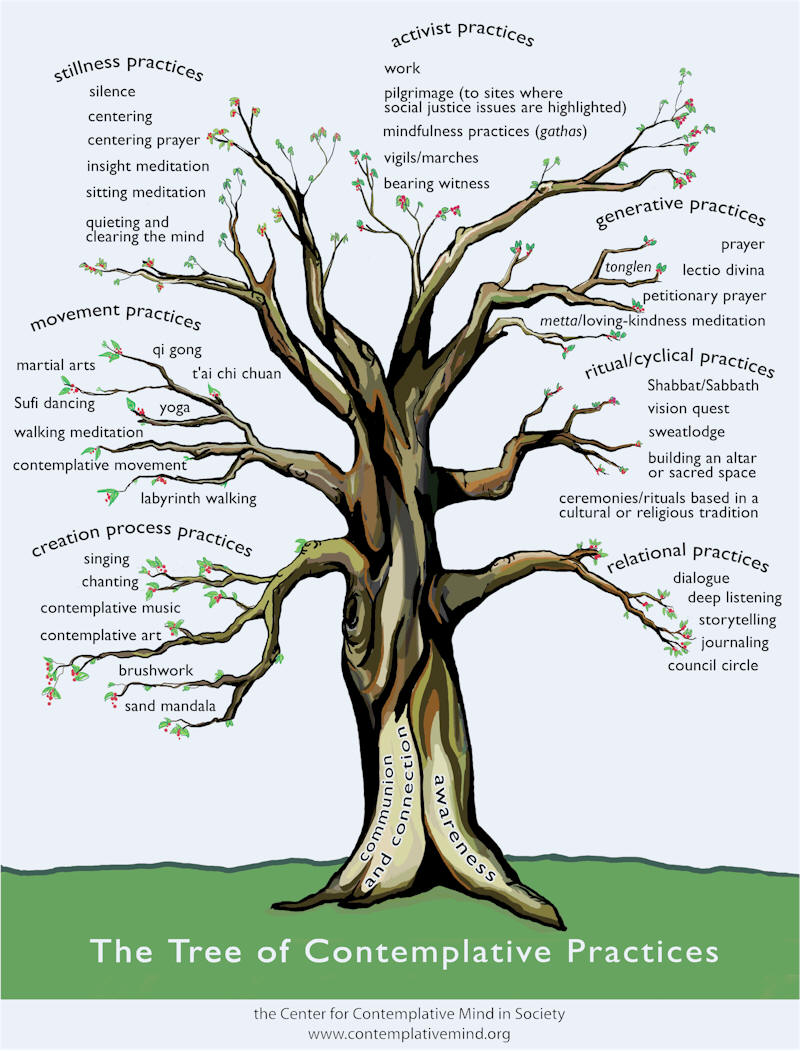
For your summer reading, we offer an array of articles addressing our inner best in as many ways as we have contributors. Enjoy them and share them with others!
- Ellen Langer, a professor of psychology at Harvard University and the author of Mindfulness, The Power of Mindful Learning and On Becoming An Artist: Reinventing Yourself with Mindful Creativity, writes on Mindfulness and Mindlessness.
- With poignancy and humor, Wolfe Zucker writes of the hard-won wisdom gained by surrendering, in Inner Life, Inner Retirement.
- Rabbi Zalman Schachter-Shalomi, author of From Age-ing to Sage-ing, the seminal book which inspired the conscious aging movement, shares his thoughts on Expanded Awareness and Extended Consciousness.
- Our resident philosopher, John G. Sullivan, offers his thoughts on Living Mindfully Through All the Hours of Our Days.
- And, finally, book page editor Barbara Kammerlohr immerses herself in of two Eckhart Tolle’s books: The Power of Now and The New Earth. Thousands followed Tolle and Oprah’s online course where the power of technology, the charisma of a television Diva, and the clarity of a convincing teacher combined to deliver the strong, simple, ancient message which is the theme of this issue: Be here now.
Happy conscious reading!
Françoise Ducroz
Mindfulness and Mindlessness by Ellen Langer
Ellen Langer, a full professor in the Psychology Department at Harvard University, is the author of Mindfulness, The Power of Mindful Learning, 6 other academic books and over 200 research articles that explore her interest in the illusion of control, aging, decision-making, and mindfulness theory.. In her recently published book, On Becoming an Artist: Reinventing Yourself Through Mindful Creativity (2005), she brings together her two lives, artist and psychologist.
Before the airport in Provincetown, MA. was renovated, a large glass wall looked out over the runway. Waiting for a friend to arrive, I asked the person behind the counter when the flight from Boston was expected. She said it should be on time. There was no one else either in the airport or the surrounding area. I was less than two feet from her when the plane in full view arrived. Rather than lean over and just tell me that was it, she announced the arrival over the public address system filling the empty room with the information.
I frequently found myself frustrated. People did not seem to be acting in a way that I thought was sensible. When I moved from New York City to Cambridge I’d notice things like lines at the bank. In one line there would be two people and in others there would be five or more. Why didn’t they join the shorter line? Why were smart people not making use of the information available to them? Was I at times acting this way as well? Indeed I was. What I realized, though, was that in a different context our behavior made sense. Here it appeared mindless.
Many experimental investigations followed to assess how mindlessness comes about and how pervasive it may be. Mindlessness comes about in two ways. Either through repetition or on a single exposure to information. The first case is the more familiar. Most of us have had the experience, for example, of driving and then realizing, only because of the distance we have come, that we made part of the trip on “automatic pilot,” as we sometimes call mindless behavior. Another example of mindlessness through repetition is when we learn something by practicing it so that it becomes like “second nature” to us. We try to learn the new skill so well that we don’t have to think about it. The problem is that if we’ve been successful, it won’t occur to us to think about it even when it would be to our advantage to do so.
Context and Perspective versus Rule and Routine
We also become mindless when we hear or read something and accept it without questioning it. Most of what we know about the world or ourselves we have mindlessly learned in this way. An example I’m particularly fond of is of my own mindlessness that I wrote about in The Power of Mindful Learning. I was at a friend’s house for dinner and the table was set with the fork on the right side of the plate. I felt like some natural law had been violated. The fork “goes” on the left side! I knew this was ridiculous. Who cares where the fork is placed. Yet it felt wrong to me, in spite of the fact that I could generate many ways it was better for it to be placed on the right. I thought about how I had learned this. I didn’t memorize information about how to set a table. One day as a child, my mother simply said to me that the fork goes on the left. Forever after that is where I am destined to put it, no matter what circumstances might suggest doing otherwise. I became trapped without any awareness that the way I learned the information would stay in place in the future. Whether we become mindless over time or on initial exposure to information, we unwittingly lock ourselves into a single understanding of that information.
When we are mindless, we are trapped in rigid mindsets, oblivious to context or perspective. When we are mindful we are actively drawing novel distinctions, rather than relying on distinctions drawn in the past. This makes us sensitive to context and perspective. When we are mindless, our behavior is rule and routine governed. Essentially we freeze our understanding and become oblivious to subtle changes that would have led us to act differently, if only we were aware of them. In contrast, when mindful, our behavior may be guided rather than governed by rules and routines, but we are sensitive to the ways the situation changes.
For those of us who learned to drive many years ago, we were taught that if we needed to stop the car on a slippery surface, the safest way was to slowly, gently, pump the brake. Today most new cars have anti-lock brakes. To stop on a slippery surface, now the safest thing to do is to step on the brake firmly and hold it down. Most of us caught on ice will still gently pump the brakes. What was once safe is now dangerous. The context has changed but our behavior remains the same.
I learned that horses don’t eat meat. I was at an equestrian event and someone asked me to watch his horse while he went to get him a hot dog. I shared my fact with him. I learned the information in a context-free, absolute way and never thought to question when it might or might not be true. This is the way we learn most things. It is why we are frequently in error but rarely in doubt. He brought the hot dog back. The horse ate it.
Absolute versus Conditional Language
When information is given by an authority, appears relevant, or is presented in absolute language, it typically does not occur to us to question it. We accept it and become trapped in the mindset, oblivious to how it could be otherwise. Authorities are sometimes wrong or overstate their case, and what is irrelevant today may be relevant tomorrow. When do we want to close the future? Moreover, virtually all of the information we are given is given to us in absolute language. A child, for example, may be told, “A family consists of a mommy, a daddy and a child.” All is fine until daddy leaves home. Then, just like where the fork goes, it won’t feel right to the child when told, “We are still a family.” Instead of absolute language, if told that one understanding of a family is a mother, father, and a child, the problem would not arise if the circumstances change.
Language too often binds us to a single perspective with mindlessness as a result. As students of general semantics tell us, the map is not the territory. In one of our studies, Alison Piper and I introduced people to a novel object in either an absolute or conditional way. They were told that the object “is” or “could be” a dog’s chew toy. We then created a need for an eraser. The question we considered was who would think to use the object as an eraser? The answer was only those subjects who were told, “It could be a dog’s chew toy.” The name of something is only one way an object can be understood. If we learn about it as if “the map and the territory” are the same thing, creative uses of the information will not occur to us.
Much of the time we are mindless. Of course we are unaware when we are in that state of mind because we are “not there” to notice. To notice, we would have had to be mindful. Yet over thirty years of research reveals that mindlessness may be very costly to us. In these studies we have found that an increase in mindfulness results in an increase in competence, memory, health, positive affect, creativity, charisma, and reduced burnout, to name a few of the findings.
Much of the early research I conducted on the topic was with elderly populations. In many studies we found that simply providing opportunities for these adults to experience novelty resulted in dramatic improvements in well being. In fact we found that increasing mindfulness by providing choice or simply instructing people to think in novel ways about familiar things had the effect of increasing longevity.
One way to break out of our rigid mindsets is to meditate. Meditation, regardless of the particular form, can lead to a post-meditative mindfulness. Meditation can be found in all cultures. In Eastern meditation such as Zen Buddhism or Transcendental Meditation, typically the individual is to sit still and meditate for twenty minutes twice a day. If done successfully over time, the categories we mindlessly committed to start to break down. Many Westerners have trouble sitting still for ten minutes once a day, no less twenty minutes twice a day. The path to mindfulness that we have studied may be more congenial to those in the West. The two are by no means mutually exclusive. In our work we provoke mindfulness by active distinction-drawing. Noticing new things about the target, no matter how small or trivial the distinctions may be, reveals that it looks different from different perspectives. When we learn our facts in a conditional way, we are more likely to draw novel distinctions and thus stay attentive to context and perspective.
Most aspects of our culture currently lead us to try to reduce uncertainty: we learn so that we will know what things are. Instead, we should consider exploiting the power of uncertainty so that we can learn what things can become. Mindfulness that is characterized by novel distinction-drawing or meditation that results in post-meditative mindfulness will lead us in this direction.
Inner Life and Inner Retirement by Wolfe Zucker
Wolfe Zucker, MSW, is retired from psychiatric hospital work, most ambitions, and his shoe collection. He’s perfecting gardening, napping, and friendships. After time at the Findhorn Community, he’s now “focalizing” spirituality workshops for elders. He remains acutely aware that not everything can be learned from writing, reading, or thinking. He’s “nowing” along as best he can.
Even after reading Eckhart Tolle, when it comes to surrendering, I am more of a bandit than a Buddha. My editor, who is also my wife, tosses back my first draft and says: “Go deeper. Describe the inner life. Describe freedom. Describe surrender.
Talk from the place of awakening… You can still be funny”. She adds happily.
Inner life is joy, it’s not funny. I stay there for a few moments at a time, and I’m too happy to joke or observe humans. I experience “foiblelessness,” though I see you the same.
Over the years, I have been in a state of “heavenly elopement” a few times. Actually, each time I visited the Findhorn Community in Scotland.
Happiness is when I am nowhere physically, but present where I am standing.
After studying with a teacher in Florida, I now know how to get there quicker and without traveling. Yet, I left the teacher. I wasn’t staying in the soul experience. And when I faded out, I was blamed. Not healthy by my standards.
Teachers are wonderful. They hold out the promise and expectation of fulfillment. But other people’s promises are like sending a package in the Mexican mail—it doesn’t arrive or it arrives with pieces missing. I now face the fact that I need to spend my whole life teaching myself.
I know it’s up to me.
Here’s what I found worked to enter a place of inner “retirement.”
I accept that I create my own life. I accept tjat all I can change is myself. I accept that my inner place is peaceful. I obtain those few moments by telling myself, “I am now in the place of my inner/higher self.” I experience a “click”, a few deep breaths, and a real connection to “oneness” and breathing and experiencing and a floating in a place where my mind isn’t working.
Then, plop, gone.
So I start over.
Click, float, think, plop.
The rewards from being in my higher world, however short, stay in my life and memory. That’s the good part. Those moments are more precious than all my time living; they remain. The times at Findhorn where I woke up glowed, waiting to meet people each day with a feeling of awe. What would happen today? What would I learn or teach or experience? I felt sure, complete, and present.
Wisdom, I believe is not “wiseness” but an unconditional state of non-attachment. In my best learning, I surrender a great deal of control. I find that when I go through a crisis, psychologically and/or spiritually, my mental fingernails, which held on to “beliefs,” slip off. I am actually tranquil and happier. I am in inner life.
I teach a senior’s class in ultimate values. Sometimes, after we’ve all spoken and meditated, we have slipped into the inner life. How do I know? We sit around smiling at each other at the end of class…and nobody leaves.
My task is identifying this state to the class. Once experienced and replicated, group function changes from “how-to” to “blissful being” in each other’s presence.
For me, the big clicks/shifts I’ve experienced in the last few months have happened because I gave up the lifelong beliefs that ruled me.
Let me give you some examples:
- My lifetime fear is abandonment. But Recently, I “got” that I am sufficient. I see myself living in that altered state of “satisfaction,” and I am fine. I don’t need anyone. I appreciate my wife, and I like being with her. I’m not going to suffer if I’m not with her. It would just be a different experience. The clinging ugliness dropped away.
- I experience disappointment with everything. So I am completely disappointed before I start something. In my place of higher awareness I am self-sufficient and nothing in the outside is that powerful to take all hope away (which recalling past disappointments did for me). Something shifted and I knew that all my life was exactly as it had to be so far. Asking to change it was stupid. Going over my pain in therapy was repetitive complaining. I don’t feel that big emotional wham anymore when people don’t meet my past’s unrealistic expectations.
- I am afraid of aloneness. Yet, I moved from Findhorn and rapidly created a whole new community. I did the work of getting out of the house and calling people. That is the reality — not my childhood. I saw now as now. Somehow I didn’t find the past and my stories so interesting.
- Another big magical change: I love dogs. The rescue dogs of my childhood were memories of love, which I blindly pursued a little bit like an addiction. (I was rabid pro-dog and had to protect the underdog). My condo association said no dogs. For months I planned going to an association meeting determined to change their position. Then my teacher said, “Grow up,” and I decided I should. I skipped the meeting. I let the dog issue go.
What helps me slip into the inner world? I realize that all I have is the now. I accept that I allowed my now to be shoved around by my past.
I decided, no more. The inner world is better. There I don’t need needs.
Now my mind asks, “What are you going to do with yourself?”
My goal is living in that inner place I enjoyed so much at Findhorn: gentle awareness and lit-up anticipation.
My life is now practicing living in the present. I jerk myself back with a reminder. I tell my “I” that my “soul” is in charge. We wrestle, I win. Am I beaming, glowing, and completely healthy?
No. But I am retiring into the light. It’s my goal for the second half of my life. And I mean going all the way.
Come walk with me.
Barbara Dondero, a former nun, is a life long seeker of quiet, spiritual and artistic expression who uses art to teach others how to access — and trust — their inner wisdom. For over 30 years Barbara has taught art to youngsters of all ages and, in the 1990’s, began to work with persons with dementia at the Alzheimer Resource Center of Connecticut. She helped pioneer an approach to drawing, based on the work of Dr. Lucia Cappachione, which focuses on using the non-dominant hand.
“Here is what you do,” Barbara who is left-handed writes: “First. the conscious mind writes a question or problem with the dominant hand in its habitual linear mode. After a pause in quiet meditation, an answer will emerge through the non dominant hand bringing forth intuitive and deep responses to the situation. This tool can be easily integrated with any journaling techniques.”
Extended Consciousness by Rabbi Zalman Schachter-Shalomi
When my daughter, Shel, was 8 years old, she asked me, “Abba, when you’re asleep, you can wake up, right? When you are awake, can you wake up even more?”
Awakening is what made the Buddha become the Buddha — the word Buddha meaning: “the awakened one.” Prince Siddhartha became the Enlightened One. Every spiritual
tradition has addressed this issue and in my own writing I’ve often pointed to the opportunities for extended awareness that are one dividend of our extended lifespan. I often said during my seminars, “If we don’t have extended consciousness to match our lifespan, we are dying longer instead of living longer.”
Here are several helpful activities to practice in expanding your consciousness.
- Learn a new language or a new skill, if possible, not only with your mind, but also with your body. If you learn a new language, for instance, learn to write in that language and in that script. If you learn a new skill, practice it for about 40 days until you find that your body has integrated it into its habit pattern. That will result in more of the synapses of the brain being connected and accessed and a consequent extension of consciousness.
- Exercise your imagination. When you read something stimulating in a book or magazine or see something on the tube, set the source of your information aside and — relaxing and closing your eyes — imagine what happened before, what is likely to happen afterwards. Picture the setting and characters in your mind’s eye so vividly so that you almost feel it. The more you are able to do this, the larger your awareness will have expanded.
- Create an inventory of the pleasurable experiences you have had that enhanced your sense of self-satisfaction. Order them from the mildest to the strongest. In your mind, construct a rosary that you can tell at will so that whenever you wish to change your attitude and mood you can consult that album of peak experiences. This will refresh your mind and your body as it works a subtle physiological change, increasing your T-cells (your immune-related cells) and augmenting the vigor with which you face even your diminishments.
- Study the contemplative teachings of world wisdom traditions. Many a time you have had moments of inspiration and ecstasy that, alas, disappeared from your memory. While they are difficult to access, often because you don’t have good concepts for them, studying one form of inner teachings — as can be found in the Kabbalah, Christian mysticism, Sufism, the Vedanta and Buddhism — will give you a grid to better recall those experiences. Then, using your imagination, paint on the inner canvas of thought and feeling a scene that captures that ecstatic moment, that revelation, that theophany. Then, make for yourself a marker, a motto, or a gate which allows you to re-enter that experience at will.
- Before you go to sleep, recall some of these ecstatic moments and fall asleep as you hug them, expecting to have good dreams. If you remember your dreams upon waking, record them in your journal.
- Mentor and tell oral history to the people in your family or among your friends who would be interested in some of your reminiscences. If they are younger and have a different map of reality than you, then communicating with them is bound to expand your mind in their direction. Consider how the young ones can handle things of complexity like the Rubik’s cube and the esoteric parts of computer use with ease. Communicating with them will also help you expand in that direction.
- Find a piece of music you are fond of and then, when no one else is in the room, as you play it, dance to it in free-form. Visualize yourself, on the inside, as a great ballet dancer so even it you cannot fully execute the movements that you imagine, your imagination and what you can do will provide you with a way of expanding your consciousness — not only in your head and your heart, but also in your thighs and toes, so that they too will become awakened.
- When you enter the December period of your life, it pays to recall loved ones who have passed on in the most vivid way you can. This will open entrance for you into the regions you are destined to inhabit after you drop your body.
These activities will be more delightful if you do them with a trusted friend in spiritual intimacy. Designate a day or a weekend for the two of you to pamper your souls. I don’t want to call this a “retreat” or a “spiritual practice” because these words tend to tighten us up as if we had to produce something rather than nourish our spirit. Such days will be a matrix for the expansion of awareness.
//
Throughout most of history, elders occupied honored roles in society as sages and seers, leaders and judges, guardians of the traditions, and instructors of the young. They were revered as gurus, shamans, wise old men and women who helped guide the social order and who initiated spiritual seekers into the mysteries of inner space. Beginning with the Industrial Revolution, with its emphasis on technological knowledge that often was beyond their ken, elders lost their esteemed place in society and fell into the disempowered state that we now ascribe to a “normal” old age. Today, as the Age Wave crests all about us and we confront existential questions about the purpose of our extended longevity, we are searching for new myths and models to ennoble the experience of old age.
The model I’m proposing envisions the elder as an agent of evolution, attracted as much by the future of humanity’s expanded brain-mind potential as by the wisdom of the past. With an increased life span and the psycho-technologies to expand the mind’s frontiers, the spiritual elder heralds the next phase of human and global development.
— From Age-ing to Sage-ing.
Living Mindfully Through All the Hours of Our Days by John G. Sullivan
Once upon a time, in a time that is never and always, a young prince in India learned of a pearl of great price – a pearl that would bring all good things. He wandered far and wide over the world — through kingdoms and cities, over mountains and across seas. And, though many had heard tales of such a jewel, no one could say where it could be found. After many years seeking, the prince returned home, exhausted and disappointed. Before entering the palace of his father and mother, he stopped in the courtyard to wash away the dust of his journeying. As he gazed into the mirror-like water, he caught sight of the pearl. The pearl he sought shone forth from this forehead.
Was the pearl there all along? Did the seeking serve to make it manifest? Was it only evident after the striving ceased and the prince returned to himself, to his place, to elemental realities such as the water in the crystal-clear pool?
We shall not cease from exploration
And the end of all our exploring
Will be to arrive where we started
And to know the place for the first time.1
The story I have told has many variants. All lead back to this: Where is the mystery to be found? In us. In the ordinary. In what lies before us and around us. In the here and in the now. Present moment, wonderful moment. There is paradox here as well. As one Zen saying has it, “No one will find it by seeking yet only the seekers will find it.”
Perhaps our progress lies in going from noun to adjective to adverb. Are we seeking mindfulness (a noun)? Are we seeking a quality such as mindful living (where “mindful” is now an adjective)? Or are we seeking a way of living where we focus as much on how we act as on what we do? In other words, are we seeking to live mindfully (an adverb)? I believe that the humble adverb points the way.
//
Living Mindfully in the Morning of our Life2
Our principal guide to living mindfully will be the gentle Vietnamese Zen Buddhist monk, Thich Nhat Hanh. He is affectionately called by the many who have learned from him “Thây” (pronounced “tie” and meaning “teacher” in Vietnamese). During the Vietnamese War, he stood for peace, and thus both sides came to suspect and oppose him. At the war’s end, he was forced to go into exile in France. There he set up a monastic community called Plum Village. He took as his work to care for the children of war. For his engaged peace work, Martin Luther King, Jr. nominated him for the Nobel Peace Prize. In October of 2008, on what he would call his Continuation Day (rather than Birthday), he will be 82. He is one of the truly great-souled figures among us.3
Because Thây loves to work with children, his teaching bears the mark of a great simplicity. How might we start, as beginners? Start with breathing. Start with smiling.
Breathing in, I am aware that I am breathing in.
Breathing out, I am aware I am breathing out.
Breathing in, I calm my body.
Breathing out, I smile.
Simple mantras. Simple practices. Conscious breathing is entry point. With conscious breathing, mind and body come together much as, in the Buddhist tradition, a person brings palms together before making a bow. As one Plum Village song has it: “I have arrived. I am home. In the here and in the now.” To live mindfully is to bring awareness into the present moment.
Beginners at meditation might be taught in this way: When you are meditating, you may notice thinking arising. Say to yourself “thinking” and return to the breathing. When you notice sensations arising, name the sensation and return to the breathing. When you notice emotions such as irritation or anger or loneliness arising, name the emotion and return to the breathing. In this way, you are aware of stories and emotions arising. You note them. You do not identify with them. The thoughts and emotions are like geese flying over the still waters of your mind. As the Zen proverb puts it: “The wild geese do not intend to cast their reflection. The water has no mind to receive their image.”4
This attentive mind that is not caught by the inner or outer weather is called in some traditions “the observing self” or “the witness mind.” We might also call it the “listening mind.” Cultivating this capacity to observe with discernment but not judgment, to observe with compassion, to listen with loving kindness is a part of mindfulness training. Our aim is to bring awareness to whatever is happening and also notice the stories we are generating and the emotions we are calling forth. The instructions are neither to act out the stories and emotions nor to repress the stories and emotions. Allow them to come and go without your becoming caught up in them. This form of meditative mind can be brought to whatever we do. We can walk mindfully, eat mindfully, converse mindfully, prepare supper mindfully, wash the clothes mindfully and on and on.
Will we remain steady? Most likely not. We may find ourselves seduced by personal and cultural stories that lead away from the here and the now. We may find ourselves buffeted by likes and dislikes. Attracted to this and repelled by that. Then it is so wonderful to realize that we have simply to begin again. Return to our bodies and our breathing. Return to the present moment, wonderful moment. Calming and smiling. As we return deliberately to beginner’s mind, we begin again each morning of each day.5 At the dawning of the day, we commit again to live mindfully for the sake of all beings, for what is before us and for the community that surrounds us. So it is in the morning of our life.
//
Living Mindfully in the Daytime of our Life
AT MIDDAY, WE ARE HOUSEHOLDERS BUSY ABOUT MANY THINGS — concerned with work and family, sensitive to praise and blame, seeking to be admired, rewarded, striving to be “somebody” that has a place in the social world. Can we resolve conflicts mindfully? Meet deadlines mindfully? Engage in intimacy mindfully? Care for children mindfully?
In the morning of a day or life, we set an intention: to live mindfully. This may indeed remain our practice. Yet by midday, it is often life’s issues that prompt our practice. The bell of mindfulness rings in the very distractions that beset us. Some may be outward events. The car breaks down. The raise did not come. A sickness in the family. Not as we want it to be.
Yet how we choose to relate to what is before us makes all the difference. And this leads us to notice that there is always more than one way to relate to anything. In fact, there are usually multiple ways. Some are larger-minded ways and some are smaller-minded ways. When we have an observing self, we have a choice and we see that it is much more helpful to all when we choose large mind.6
Yes, the trigger often seems to come from without. Yet one person in the face of such disappointing news is devastated; another can proceed quite differently, with less unnecessary suffering and more possibility for all. So we notice that even when the prompting event arises outside us, we are the ones who interpret the event and tell stories we tell about it (and us). Even when the prompting event is outside us, we are the ones who generate the added emotional charge to it. So living mindfully is noticing what is happening and also noticing how I am labeling and telling stories about what is happening. Noticing what is happening and also noticing how I am producing emotions around what is happening.
- In the midst of our busyness, the advice at railroad crossings becomes a mindfulness bell, saying: Stop, Look, and Listen. Returning to our breathing aids us to stop. Looking with compassion at what is happening and how I am adding meaning and emotion to what is happening opens the heart. Listening to our deeper nature places surface disturbances in fuller context.
- In the midst of our busyness, we may find ourselves replaying the past or rehearsing the future. Then we may find the antidote in the poison, letting the upset lead the way to a gentle noticing. “There I go again. Doing that. Not very helpful. Yet quite human.” A compassionate smile and a return to the breathing.
- In the midst of our busyness, we may find ourselves justifying and defending ourselves, blaming others and complaining about situations. Again, find the antidote in the poison. Let the upset lead the way to a gentle noticing. Return, as the Sufis say, to the root of the root of yourself.7
Stop, Look, and Listen. Here from Thich Nhat Hanh is a song to remind us:
Happiness is here and now
I have dropped my worries
Nowhere to go, nothing to do
No longer in a hurry.
Happiness is here and now
I have dropped my worries
Somewhere to go, something to do
But I don’t need to hurry.8
//
Living Mindfully in the Evening of our Life
We are frightened of decline. Even in our final years, we turn away. So here is a story to give us courage.
Another prince from India, Gautama Siddhartha was destined to become the Buddha (literally, the one who awakened). His father had marked him for kingship and provided him with all pleasures. The one thing forbidden was to leave the vast precincts of the palace. One day, the young prince left the palace precincts and he noticed a sick person, an old person, a dead person and a monk. He learned that in the world there was not only health, but sickness, not only youth but age, not only life but death. How could he live his life, aware of both realities? The monk provided a glimpse of another way to be. Gautama, who had followed the path of self-fulfillment, would now experiment with the path of self-denial. Yet neither gave the answer. So he determined to meditate until he broke through to a middle way. And so he did. After his enlightenment, the Buddha taught the Five Remembrances:
- There is sickness and no way to escape this.
- There is aging and no way to escape this.
- There is death and no way to escape this.
- All we know and love will change and there is no way to escape this.
- All we do will persist and there is no way to escape this.9
We might say: Can we face sickness and aging and death mindfully? Can we be with change mindfully? Can we enact all our thinking and speaking and doing mindfully and peacefully and gratefully, realizing that all we do endures?
The grandfather of western philosophy, Socrates, once said that philosophy — in its root sense of love of wisdom (philo=love; sophia=wisdom) — is the art of dying. Dying to expectations, we return to life as it is – in its surface and depth manifestation. In a certain sense, we let life be as it is and realize that the mystery is much more vast than we can imagine. Call it the Great Unfolding of the Cosmos. Call it the will of the Holy One. Call it the Tao – the Way of the Universe. When we align to these deeper currents, we realize more fully the words of another song dear to Thây’s followers:
I have arrived. I am home.
In the here and in the now.
I have arrived. I am home.
In the here and in the now.
I am solid. I am free.
I am solid. I am free.
In the Ultimate I dwell.
In the Ultimate I dwell.
So in the end what we are seeking is always with us, before us everywhere we go. As close to us as a pearl embedded in our forehead. Present before us in the here and in the now, seen deeply and loved ever so tenderly. I see the Chinese poet Wu-men Hui-k’ai (1183-1260) revealing the pearl of great price when he writes:
Ten thousand flowers in spring, the moon in autumn,
a cool breeze in summer, snow in winter.
If your mind isn’t clouded by unnecessary things,
THIS is the best season of your life.10
//
Notes
1 See T. S. Eliot, The Complete Poems and Plays 1909-1950 (New York, Harcourt, Brace and Company, 1958), p. 145.
2 I structure this essay using the metaphor of morning, daytime, and evening of a life. In writing, I was reminded of a song by Barry Gibb (1966) titled “In the Morning” and made famous by the great Nina Simone.
3 Thich Nhat Hanh has written more than one hundred books, sixty in English. I would suggest beginning with his Peace is Every Step: The Path of Mindfulness in Everyday Life (New York: Bantam Books, 1992) and his Being Peace (Berkeley, CA: Parallax Press, 1987).
4 From the Zenrin Kushu, quoted in Nancy Wilson Ross, The World of Zen (New York: Random House, 1960), p. 258.
5 The notion of returning to Beginner’s Mind is prized in Zen teaching. See Shunryu Suzuki, Zen Mind, Beginner’s Mind (New York: Weatherhill, 1970).
6 For more on this way of speaking about practice, see my book Living Large: Transformative Work at the Intersection of Ethics and Spirituality (Laurel, MD: Tai Sophia Press, 2004), especially chapters 1-4.
7 Here I am alluding to a poem of Rumi, titled “The Root of the Root of Yourself.” See Love is a Stranger, translations of Rumi by Kabir Helminski (Brattleboro, VT: Threshold Books, 1993), pp. 16-17.
8 Many of the chants used at Plum Village are published. See Plum Village Chanting and Recitation Book, compiled by Thich Nhat Hanh and the Monks and Nuns of Plum Village (Berkeley, CA: Parallax Press, 2000). However, this “Happiness is here and now” song and the “I have Arrived” song that I quote later are songs I learned either from seasoned practitioners of Thây’s teachings or at a retreat with Thây at Stonehill College in Easton Massachusetts, August 12-17, 2007.
9 The wording here is mine, based on Thich Nhat Hanh’s rendering in his more advanced treatise, Understanding Our Mind (Berkeley, CA: Parallax Press, 2006), p. 218 and following.
10 See The Enlightened Heart: An Anthology of Sacred Poetry, ed. by Stephen Mitchell (New York: Harper and Row, 1989), p. 47.
Books of Interest: Two Books by Eckhart Tolle Reviewed by Barbara Kammerlohr
A New Earth: Awakening to Your Life’s Purpose
by Eckhart Tolle
Plume Books, 2005
The Power of Now: A Guide to Spiritual Enlightenment
by Eckhart Tolle
Namaste Publishing and New World Library, 1999
In this issue, we review two of Eckhart Tolle’s books, A New Earth and The Power of Now; both related to our theme of inner work and both veterans of The New York Times bestseller list. Tolle is a contemporary spiritual teacher whose recent web-based class with Oprah Winfrey made his name a household word and, therefore, a perfect choice for this issue’s book review section. Understanding inner work and how to do it becomes more important the further we move into our second journey. Tolle’s teachings are one example of how to proceed with this important task.
Aging consciously demands that we not only attend to our own inner impulses and goals, but that we make important decisions based on information we collect from that inner self. To say that this task demands clarity is an understatement. Yet, clarity can come from a purposeful inner listening to our own wisdom. What is our purpose in living now that society no longer defines it for us? What legacy do we want to leave for our children and grandchildren? Which of our skills and talents will we develop in order to continue contributing to the welfare of our society? Where do we want to live now that the decision is no longer determined by the morning commute? Answers do not come easy to those of us steeped in a tradition of denying old age and confused by society’s stereotypes of aging.
“How do I find answers to those questions?” is a question I frequently get from readers of this column and from my classes on conscious aging. The answer is awareness. Experienced meditators and veterans of other systems of inner exploration such as journaling, yoga, dream work, contemplation, prayer, tai chi, vision quests, etc. understand that answer immediately. Others, who might have avoided looking within themselves for answers and accepted the roles and expectations assigned by society, need an explanation of the terms: “inner work, consciousness, awareness”. Tolle’s teachings are one way to approach the process. There are many others, specifically those mentioned throughout this issue and illustrated by the Tree of Contemplative Practices, but Tolle seems to be emerging as one of the most widely accepted contemporary spiritual teachers. Tolle’s message is simple and ancient: ” Be here and now” which is both the practice of mindfulness and its greatest gift.
Tolle’s teachings are similar to the core insights of most of humanity’s spiritual traditions, especially mystical Christian thought and paths with roots in the East. All agree on the following two points:
- The need for a transformation of consciousness, a spiritual awakening. “The normal state of mind of most human beings contains a strong element of what we might call dysfunction or even madness…” “This collective manifestation of the insanity that lies at the heart of the human condition constitutes the greater part of human history—wars, slavery, torture and widespread violence inflicted for religions and ideological reasons.”
- The good news of the possibility of a radical transformation of the human condition. “In the teachings of Jesus, it is salvation, and in Buddhism, it is the end of suffering.” Liberation from the ego and awakening to and acceptance of what is here and now are other terms used to describe this transformation.
Tolle believes that simply being in the present moment is the key to awakening—ending personal suffering and transcending this ego-based state of consciousness. This is a prerequisite, not only for personal happiness, but also for the ending of violent conflict endemic on our planet. The following quotation hints at just how important he considers this focus on the now:
“When you don’t cover up the world with words and labels, a sense of the miraculous returns to your life that was lost a long time ago when humanity…became possessed by thought. A depth returns to your life. Things regain their newness, their freshness, and the greatest miracle is the experiencing your essential self as prior to any words, thoughts, mental labels and images.”
Tolle’s philosophy comes from his own unique experience of awakening. That experience convinced him that focusing on the present moment is the way to awaken.
“All negativity is caused by an accumulation of psychological time and denial of the present. Unease, anxiety, tension, stress, worry—all forms of fear—are caused by too much future, and not enough presence. Guilt, regret, resentment, grievances, sadness, bitterness, and all forms of nonforgiveness are caused by too much past, and not enough presence…”
“The most important relationship in your life is the relationship with the now—the present moment.”
Tolle’s instruction about how to achieve more focus on the now differs from the instruction given by most Buddhist and Yoga teachers who teach that meditation is the key to awakening, To Tolle, it is all about finding ways to stay centered in the now. Meditate, if you find it helpful, but “formal meditation is no substitute for bringing space consciousness into every day life” The key is to stay centered in the present moment—now. The past is gone. The future is yet to be. All we have is now. To Tolle, the most important factor in awakening is the ability to stay centered in the present. One technique for maintaining that focus is the awareness that all things pass: He said:
“Live in the awareness of the fleetingness of every situation. This too shall pass. When you are detached, you gain a higher vantage point from which to view events in your life instead of being trapped inside them. With detachment, another dimension comes into your life—inner space.”
A New Earth (2005) and The Power of Now (1999) both reflect the same philosophy of awakening. In A New Earth, however, the ideas seem to be more mature, more carefully explained. It also amplifies an idea only introduced in The Power of Now, Tolle’s belief that humanity is now ready for a major shift in consciousness, an awakening, “an inner flowering so radical and profound that compared to the flowering of plants, no matter how beautiful, is only a pale reflection.
Tolle, the author of these two and Stillness Speaks, was born in Germany and educated at the Universities of London and Cambridge. At age 29, a powerful inner transformation radically changed the course of his life. Since 1995, he has lived in Vancouver, Canada. His website is www.eckharttolle.com.
Embracing Generations and the Larger Community by Dorit Fromm
A fellowship brought Dorit Fromm to Denmark for the research on cohousing communities which she later wrote about in the Architectural Review. She received a National Endowment for the Arts grant to research European collaborative housing, the basis of her 1991 book, Cohousing, Central Living and Other New Forms of Housing. She has worked as an architect, was communications director for ELS Architects, and has researched senior cohousing in the U.S., Netherlands, Denmark, Germany, and Sweden. Dorit writes about architecture, communities, and aging, with articles in Metropolis, the Architectural Review, Urban Land, and other publications. In 2006 she spent a year in Europe, researching examples of housing for seniors. She now consults with design and development firms on communications and collaborative senior-friendly developments.
Many years have passed since I first started looking at collaborative communities in Europe and in the United States. The questions I had then, balancing career, marriage, motherhood, and friends, have been partly replaced by time, and new unresolved questions have emerged. Many have to do with the transitions of aging, and a curiosity about how collaboration could work to improve day to day life as I age. How can our housing and communities help us balance this new phase of life?
A few years ago I had the opportunity to live in Europe for a year, and I made a shorter return visit this summer. I knew Americans were aging at a fast rate; but few realize that Europeans are graying even faster. Within 40 years, almost a third of their population is expected to be seniors versus a fifth of the cohort of boomers in the U.S. Northern Europeans have paid high taxes all their lives. Unlike many of us, they have the expectation of receiving nationally subsidized care and appropriate housing as they age. Unfortunately, such a cradle-to-grave social contract cannot hold when nearly 1 out of 3 will be over the age of 65.
With a limited window of time, Northern Europeans have already started creating alternatives, spurred by nonprofit organizations, municipalities, foundations, and self-organized groups. Interestingly to me, instead of concentrating exclusively on elderly facilities, the focus is on strengthening neighborhoods with a multi-generational approach. The results so far are a variety of senior-friendly developments that embrace generations as well as surround residents.
Neighborhood Centers
In Germany, I not only saw the continuing unification of east and west through building and economic programs, but also heard much discussion on social unification. Coupled with a high number of seniors (20% of the population is over 65 and rising), there is a strong interest in helping seniors age in place and in strengthening communities.
Taking the idea of the private extended family of the past and re-interpreting it through a public network, multi-generational neighborhood centers bring generations in a community together. The “mehrgenerationenhäuser” combine some of the services of a senior center, health clinic, pre-school and youth group at a neighborhood level. Located in church basements, on the ground floor of nonprofits or senior centers, or within high-rise housing towers, they usually are placed into under-utilized spaces. Activities include whatever the local community wants and needs, from exercise and health classes to infant care.
In 2006, the German government launched a well-funded initiative to create 500 neighborhood centers. That ambitious number has already been reached this year (2008). Volunteers working with professionals run the center. Their overall aim is mutual support, whether through classes, services, programs, or simply drop-in visits.
Balancing Generations
The neighborhood centers evolved from experiments and models that had already met with success in Germany in delivering affordable services. One of these, a model I had never come across elsewhere, can be found in southern Germany, in Swabia. I find it interesting because developments for the elderly tend to either focus on independent seniors or frail seniors, but don’t usually mix the two; nor do they typically add in a younger generation of residents, along with affordable housing and services. This intergenerational model is the product of the St. Anna Foundation, nonprofit developers and managers of housing for the elderly. Gerhard Schiele, their research and community director, believed that, as in the past, people would informally help each other if a supportive environment was in place. In 1990, he had the idea of creating housing for the elderly that gave them the chance to continue to live independently, but among other generations. A community framework would help them remain fit and socially connected, prolonging wellness. Schiele’s housing model started with the idea that two-thirds of residents would be over 60 years of age; one-third would be below. A sizeable amount of common space was included, with a part-time social worker to help residents organize common activities, such as a catered lunch. Funding comes from St. Anna’s, from the municipality where the developments are built, and from donations. This money is placed in a social fund which pays for social workers, one half-time social worker for approximately 40 residents.
When the first development opened in 1994, critics felt professionals should be looking after older, somewhat frailer residents, not their neighbors. But to their surprise, the scheme worked well. Since then, 25 developments have been built. They range from 13 to 80 units, all handicapped accessible. Though affordable and open to all, residents who live in the municipality where a development is located are given preference. Providing mutual support and participating in common activities is done voluntarily; no one is required to do so. With a total of 800 units, and well over a decade’s track record, they have proven their success.
In one development in the central part of Ravensburg the morning begins in the community’s common space with a play group for toddlers and pre-schoolers, which is organized and run by residents and volunteers. Karin Bruker, a social worker from St. Anna’s, helps schedule and coordinate this and many other activities, including exercise and arts classes, as well as information on health. A catered lunch, the large meal of the day, is served in the main common space to senior residents and others from the neighborhood who pay for this with a small fee. Aside from scheduling events and bringing residents together informally — such as the monthly resident meeting with cookies and drink — Karin’s services are providing advice, tips on health, and integrating the community of residents into the larger neighborhood. The surrounding community can participate in events and rent out spaces for a small fee.
Residents, a mix of owners and renters, can voluntarily work in the garden, do maintenance, and informally help neighbors by shopping, cooking, and occasionally babysitting. When greater care is needed by older residents, St. Anna’s provides in-home aides and nursing care for a fee, and guarantees admittance to their nearby nursing home if long-term round-the-clock care is required.
Conflict?
This model views creating community not as a romantic notion, but as a responsibility. Those aging around us have too often acquiesced in their segregation from younger generations. Options for developing aging services through mutual help require residents with an open attitude. Monitoring is also important. Finding ways to engage young and old together requires effort, as some elderly may feel they have little to contribute of interest to the young; others have concerns about noise and worries about security. Many younger people, who may not live close to their own aging relatives, have no idea of how to relate to this growing segment of the population.
Moving from environments of age segregation to integration invites interaction and the inevitable differences of opinion in behavior, attitude and outlook. “It’s a lifestyle for people who like to live in the center of things, with activities going on,” explains Anne Oschwald, of St. Anna’s.
An attitude of working out conflicts and not avoiding them is required. In a model like St. Anna’s, the social workers not only help residents to help each other, they are also trained in mediation. Along with activities and opportunities for getting together is the safety net of having a non-involved third party available to smooth out differences, if necessary. Any resident or neighbor can come and ask for a social worker’s mediation services. If a particular person isn’t getting along with others to the point of continuing to cause conflict, and mediation is not successful, “we work with them to find another living alternative because they’re not happy living here,” explains Karin. According to St. Anna’s, this has happened twice over the past 14 years.
Contributing
Studies in Europe that look at the components of successful aging have had an impact on European aging policy. The Leiden-85 study, carried out in the town of Leiden in the Netherlands, looked at 85-year-olds in the community to identify the components of “optimal functioning and well-being.” For overall well-being, social contact was found to be most important. In the U.S., a study at the University of San Diego by Jennifer Reicstadt, M.S., and her colleagues found that “a sense of engagement … and being useful to others and to society, was considered a prominent aspect of successful aging.”
Contributing to the lives of other people increases social contact and makes each of us, no matter what age, feel less passive, more animated and involved. As the ways we normally have for sharing stories, advice, or help changes — either from decreased work or the loss of losing those close to us — how can we retain a sense of engagement and usefulness rather than only a recipient’s role? From the standpoint of our own well-being as we age —not to mention affordability — community may not be just an option but a necessity. If so, how do we envision it?
Here are some bold suggestions for combining generations and embracing the neighborhood, based on examples I’ve researched: site elderly housing next to a kindergarten and have both share a common courtyard; combine old age homes with community centers; have a nursing home share a cafe open to the neighborhood; and have elderly volunteers help the handicapped to jointly run a neighborhood center. And here are some new forms we might look closely at: senior-friendly cohousing-type communities that offer some neighborhood amenities, “intentional villages” for seniors such as Beacon Hill (in Boston) providing services for the whole neighborhood, for example.
New models for aging can create opportunities to re-envision care as not just for elders, but in a broader context of activating generations and neighborhoods. I’ve seen it work in other countries and know we can make it work here.
Senior Cohousing: The First Three Years, an interview with Chuck Durrett
Architect Charles Durrett has designed over 30 cohousing communities in North America and has consulted on many more around the world. His work has been featured in Time Magazine, the New York Times, the LA Times, Architecture, and a wide variety of other publications. He and his wife, Kathryn McCamant, have received numerous awards for their work including the most recent World Habitat Award, presented by the United Nations, and the Mixed Use, Mixed Income Development Award, presented jointly by the American Institute of Architects and HUD. Contact them at www.cohousingco.com.
Charles Durrett was just finishing his book, Senior Cohousing: A Community Approach to Independent Living, when I snagged a ride with him up to Nevada City, California, where he and his family were living in temporary quarters as they waited for his latest intergenerational cohousing neighborhood to complete construction.
In the interview (published in the Summer 2005 issue of Communities Magazine), Chuck shared how his own frustrations in his effort to find a reasonable housing solution for his aging mother were the catalyst for him to return to Denmark and research the emerging senior cohousing movement there. As co-author — with his wife and architectural partner Katie McCamant — of the first U.S. book on cohousing, he had a wealth of stories about why these intentional neighborhoods so effectively assisted and empowered seniors in their later years. Recently, I was able to repeat the journey with Chuck.
After spending some time in Berkeley, we took the train to Sacramento, giving us several hours to catch up on the state of senior cohousing in Denmark, Europe, and the US. Again, he told great stories of his experiences in his new home in Nevada City Cohousing and of his ongoing efforts to create a cadre of people who can teach what the Danes call (loosely translated) “Aging and Quality of Life in Community” — a crucial but, as yet, still missing educational piece needed if senior cohousing is to enter the mainstream.
Below, you’ll find the highlights of the interview, with my questions in bold. Our interview ranged widely, and I’ve done some shuffling to keep the thread of the discussion focused. Those without time to read the full article can use the links in the table to the right to access the topics that most interest them.
Senior cohousing in the US: the “big picture”
- The role of education in creating a market for senior cohousing
- An update on projects since the book came out
- Beyond age segregation: “elder-rich” intergenerational cohousing
- Overcoming fear of change: helping people make active choices for community living
- How Chuck’s own aging is affecting his understanding of community
//
Q: What’s the big picture of what’s going on as far as the senior cohousing model for aging in community is concerned? You’ve been busy for the last three years since your book came out. People are living in senior cohousing in the U.S. and creating new communities. Are you seeing some evolution of the movement?
A: The big picture, Raines, I hate to say, remains pretty unchanged from three years ago. Too many seniors don’t know how much they would gain from living in the social setting a functional neighborhood community provides. At the end of the day, when a senior desires to be with others, nothing beats proximity. The aging process does compromise our abilities to get around. So, on the one hand I feel strongly that we’ve got a long way to go. On the other hand, it’s clear that we’ve made inroads.
The experience in Denmark, where cohousing began, can be instructive. Just now, 36 years after it was built, Denmark’s second cohousing community is seriously planning its future as a senior cohousing community. The whole movement is just 17 years old in the U.S. I expect that in the next 5-10 years, there will be increasing demand for us to go back to cohousing communities and retrofit them for more and more seniors, as these communities become elder-rich.
Still, I generally believe the market share for cohousing will probably be limited to one percent of the population—UNLESS, that is, our society becomes deadly serious about the need to conserve resources.
That may happen. You know, last year in this country service-providing organizations drove five billion miles in the care of seniors. Fuel costs are starting to dramatically depress that number. Meals-on-wheels food-delivery services, for example, are dropping from daily to just one day a week. All those volunteers across the country don’t get reimbursed for their gas costs.
Bill Thomas calls this the $3 trillion problem: In the year 2018 that’s how much more money it will cost to care for seniors at the level we care for them today. It’s no longer a viable alternative. We have to get creative. And here’s the good part:—alternative solutions, besides being considerably less costly, are also much better!
But whether cohousing garners 1% of the market or 10% or 20%, one can argue — as people in Scandinavia today do — that cohousing has already affected much of the housing market—for example, the design elements in multi-family affordable housing that intentionally encourage neighbor interaction. Or, another example, single-family neighborhoods, where the residents of a street can vote to close the whole street to cars, create kid-play areas in the middle, and require people to park at both ends. A change like that vastly alters the behavior of residents and how well they know each other.
You know, we in this country spend so much money holding society together with laws and prisons and police. And yet, every study in the world has shown that if a neighborhood feels like a community, the residents will keep each other accountable. Delineating clearly what’s public and common helps neighbors feel mutual regard. They simply do things for and with each other which no municipality can afford to do. And the neighborhood bonds together, and it’s apparent that police are less necessary. At some point in our society we’re going to see that.
I live in town of 3,000 people with an annual city budget of $4 million: $1.4 million on police, less than $100,000 for planning, virtually nothing for figuring out how to provide quality of life for seniors. That is an upside-down society. It’s not obvious that anytime soon that we’re going to be able to rely on government to play a positive role. So what if I turn to my neighbors instead and that way create a mutually beneficial society. I do things for them that are easy for me and hard for them; in return, they do things for me that are easy for them and hard for me.
Q: You, an architect, have personally devoted enormous time and energy creating what I would call an educational curriculum — what you call the Study Group Process — that focuses on the transitions that are a part of aging. What is your thinking behind that?
Let me answer that with an illustration: If you were to stop 1,000 seniors at random on any street in America, you’d find only five who’d put community anywhere near the top as a requirement for their senior years. If you were to stop 1,000 seniors who had taken some kind of successful aging or aging-in-place seminar, about 400 of those 1,000 would rank community as important to their quality of life. The number 400 comes from the research the Danes have done to evaluate their own educational efforts. In America, we have to bring that five up to 400 before we have a viable movement where seniors are moving into senior cohousing communities — or, for that matter, intergenerational cohousing — one after another.
The focus of most retirement planning is on financial well-being. Many seniors, for example, are clear that they have to have post-retirement income — whether it’s from savings or from continued earning — income of, let’s say, $4,500 a month. Few, however, anticipate the many requirements for emotional well-being and the other challenges of aging. Few have fully gripped the implications of their children being grown and often geographically scattered. Their friends may have left town or died. Or they are divorced, or their spouse has died. And they’re vulnerable from an emotional point of view.
Having just finished planning Wolf Creek Lodge, a senior cohousing neighborhood, I’m rather astonished by the level of consciousness the core group participating in the planning develops. When elders spend time talking about the issues of the day and about what it means to be an elder, they get honest and open. They get out of denial. They come to grips with reality.
Several members of Wolf Creek Lodge have gone through the Study Group Process. But they’ve done it more organically (versus doing the workshop at the earliest stage of planning ). They ended up increasing their consciousness; but this happened in the middle of the planning phase, not the most cost-effective time to start rethinking design choices. So there’s a clear advantage to the design teams to get the core up to speed at the very beginning with what they need to accomplish, rather than having them figure it out as they’re planning the project.
Q: So what’s actually happened on the ground in the U.S. since your book was published? What effect is this having on people’s lives and the world?
A: Since the book came out, we’ve had three senior cohousing communities occupied — Glacier Circle in Davis, CA; ElderSpirit in Abingdon, VA; and Silver Sage Village in Boulder, CO — and twelve in the planning phases.
Just now, 36 years after it was built, Denmark’s second cohousing community is seriously planning its future as a senior cohousing community. The whole movement is just 17 years old in the U.S. I expect that in the next 5-10 years, there will be increasing demand for us to go back to cohousing communities and retrofit them for more and more seniors, as these communities become elder-rich.
Of the 12 communities in development, let me single out Wolf Creek Lodge, which is now ready to start construction. It’s a 30-household community, currently with 20 committed residents, in a semi-rural part of California. Three residents are moving from homes with 15, 17, and 20 acres each, all together with their neighbors onto 0.9 acres, a single building. It’ll be very energy-efficient, a cozy “euro-esque” environment, with many outdoor facilities around them. They’ll have access to three acres of outdoor space — including a thousand linear feet of mountain creek — that they can use without having to own them.
This community is using little resources and is walkable to downtown. The members’ goals are to live lighter on the planet and enhance their quality of life. In the planning profession, the more energy we put toward accomplishing the former, the more we achieve the latter.
Cohousing provides the opportunity to live closely with others — effectively playmates, not just neighbors. Everybody has a private house. The process results in an amazing emphasis on what can we do, what are the common facilities we can have. What can we do together to make my life more convenient, practical, economic and fun?
Living in community, it becomes increasingly obvious how people can leverage the things they own together to accomplish these feats they envision better than they can themselves on their own.
It’s like ping-pong. It’s hard to play by yourself. But in a neighborhood with 30 adults around, you are almost always assured of having the opportunity to play. And that level of engagement keeps you light on your feet, and mentally dexterous.
Q: When I’m talking to people at national aging conferences about the senior cohousing vision, even people in their 80s and 90s sometimes say “I don’t want to live with all those old people.” I’ve experienced some push-back from people reluctant to leave their longtime homes or reluctant to embrace age-specific communities that don’t include kids. How do you address this type of concern?
Besides senior cohousing, there’s an emerging concept of “elder-rich cohousing.” Over the last few years we’ve really learned to appreciate that cohousing groups may see themselves as intergenerational, because of the area’s demographics or the initial recruiting by the core group. The pattern tends to be that they recruit a lot more people over 50 than under. Although there are children, they’re not the 30, 40, 50 children that were typical of the earliest cohousing neighborhoods in the U.S.
Cohousing started out being known as an incredibly child-friendly, family-friendly environment. But who joins can vary greatly, depending on the local market. One of our current projects, La Querencia Cohousing in Fresno, started out oriented towards families, but it attracted a lot of retired people.
t’s one thing to live with people who are all 50 or 60. Most senior cohousing encompasses quite a range, from 50 to 90. There are a wide variety of attitudes and abilities, but your neighbors in general are anything but old and decrepit, anything but staid—especially because people who move into senior cohousing are pretty can-do, thoughtful, proactive, and entrepreneurial. These senior cohousing communities are anything other than the places advertised as “active adult communities” of the sort Del Webb creates.
As I’m visiting senior cohousing, I’m repeatedly astonished by the heightened level of fun these seniors are having. It’s an atmosphere akin to a college dorm, versus “this is where the old people live.” (By the way, I think that seniors and 17- to 22-year-olds have a lot in common!) The agenda of these residents is not about kids, careers, recreational opportunities. It is more about “What kind of fun can we have today? What can I do to stay interested in my day, my neighbor?”
Q: What do you say to people who are scared of senior cohousing because of the change it represents in their lives?
A: There are a lot of reasons that nearly every senior I see says, at first, “They’ll never get me into one of those.” It has nothing to do with the reality of the situation. It’s about a fear of losing control. And there’s only one way to get happier, which is to get in control.
It’s ironic that so many people think that the challenges of aging won’t happen to them, while at the same time they don’t have another plan. Cohousing gives them a plan, an option, an alternative. It’s so critical that seniors, if they’re going to come to any better solution, really need to come together, get organized, get a plan. It’s so straightforward.
Throughout Europe, where senior cohousing is well-established, they have planned guest quarters that can be utilized by caregivers when that’s needed. They might be there for just a week, or for the duration of the project.
I just got a letter from a slightly newer senior cohousing project in Denmark (the first ones were built in 1985). After eight years in residence, they had the first occurrences of people being incapacitated.
The most common question around the model is “What happens when all these people get old at the same time?” The reality is that capacity has nothing to do with age. Many 90-year-olds are more robust than their 60-year-old counterparts. The key is to stop boxing yourself in with a scenario driven by fears.
A community may have one person with slight dementia. Living in community, she never sits by herself at dinner. Who knows whether a second person will become less capacitated and overwhelm the community’s ability to provide support. One day the degree of her incapacitation may require she move to institutional care, but even then she’s developed supportive friends who will visit her wherever she ends up and will continue to play a role in her well-being. As anyone who knows anyone who has been in assisted care or nursing homes, the degree to which patients get cared for is directly proportional to the number of people looking after them.
Senior cohousing doesn’t preclude other kinds of care. In it, more people are able to realize the possibility of dying at home, or not being in an institution longer than necessary. Too often somebody breaks a hip, gets placed in assisted care, and doesn’t come back out. They feel so bad from being abandoned there that they don’t live as long as they otherwise would.
Research identifies three key components to longevity:
- eat right, mostly light
- stay active, mostly with low-impact activities
- stay connected, with friends and neighbors
You remove all three as soon as you put someone in assisted care, no matter how hard you try. There are some phenomenal staffers out there. But giving up control is fundamentally incongruent with our personal image of the conditions for living successfully.
I was asking a couple of friends, “Why don’t you live in a cohousing community?” They live in a very progressive neighborhood, in Berkeley, California, in a cute single-family bungalow. They’re as nouveau as you can possibly get. You would think from talking to them that they would be ideal candidates for senior cohousing.
“Well, you know,” Mary said, looking over at John, “we borrowed money from our parents to buy this house. Our parents thought we would succeed, so they helped us with our transition into adulthood. And to tell you the truth, I feel very self-conscious. I think that our parents would think we hadn’t made it, that we have resigned from the mainstream, if we don’t move to something expensive.”
Frankly, there are a lot of seniors who feel that their friends would think they have resigned if they don’t live on their own.
Q: How has your own aging affected your own understanding of community?
A: At 52, I don’t feel that old. In fact, emotionally I feel more like a 20-year-old. But, I’ve seen a lot of people older than me, uncles and aunts and relatives, fathers and mothers, who, once they cross that threshold of 60+, face big changes in their lives. I especially see their independence wane considerably. Their job, career, is not necessarily their life any longer, their kids are certainly not their life any longer, their friends are not as much their life as they would like them to be. I think that their lives are unnecessarily isolated.
I luckily live in a cohousing community with lots of kids, I love hanging out with the kids. We have lots of seniors and I love appreciating them. I feel very lucky. If I didn’t live in cohousing community, . I would very much want to live in small town.
When it became obvious I wasn’t going to be able to talk my wife into moving back into the small town where I grew up, I had to figure out how to simulate a small town, to the best of my ability in the more anonymous kind of suburban or urban environments we ended up living in. There was no model that consistently appeared as viable as cohousing for making the kind of relationships between neighbors healthy.
//
Raines Cohen works to build community at home and at work, as a Cohousing Coach and Co-working Coach, teaching, advising, and consulting on effective practices for creating enterprises of mutual support, sharing, and caring. He served two terms on the Coho/US board and is currently on the board of Fellowship for Intentional Community, an international support network and information clearinghouse. He works extensively in the online blogging and social networking world, creating connections between communities.
Paying it Forward by Rabbi Zalman Schachter-Shalomi
Socially Active and Engaged Elders
A while back, a group of friends and I discussed the amount of political and social activity necessary to support the environment, the earth and her people. We looked at all the activities required to take an active role in guarding the health of the planet and speaking up for her people. Who would write letters? Who would write emails? Who would organize us to voice our opinion and influence lawmakers closer to home? Would it be possible for us to create an organization where we could have one person do what needed to be done for the community? We’d have to have a salary line to support such a person or persons.
The idea, though a good one, just didn’t seem to work. Even amongst us older adults, there was not one who was interested in actually taking on the job. Some needed more than a grass-roots income; others felt the service would require too much; others felt the task was beyond their understanding.
I feel it would be worthwhile to organize a cadre of elders who have retired to serve as a clearinghouse for political and social action, as advocates for a better life on this planet to create a web of elder mind and elder caring. Such experienced voices could help us hear what the issues are, which ones to support, what rationale and stance to take.
This task of forming a visible web of actively engaged elders is part of the “November work” for us (see page 14, From Age-ing to Sage-ing, ©l995, Warner Books). How would it look? In the social-action arena, some elders could help with correspondence around local issues, telephoning, some with filing, some with running errands. Consider paying back (ask not what your country can do for you, ask what you can do for your country) and paying forward for future generations.
We could create a core of retired people to visit prisons —elder home hospice volunteers, elders reading in the schools. Retirees could become engaged by passing on their professional experience and wisdom in all occupations, thus mentoring (giving good ear and support to) younger workers who are meeting the challenges of the working world.
These would have two benefits: recipients of the care from elders would benefit from personal attention, understanding and experience of the elder, and the elders themselves would find inspiration and enthusiasm for the work they do for others.
Giving back to the organization of the social fabric, we could see a parish, a ghetto, a neighborhood, a community where elders are naturally involved. Where elder minds support those who are breadwinning and do not have time to spare for the daily tasks that require presence.
Paying it forward, we would find that when our time comes to be in a retirement home, in hospice, or diminished in our own home, there would be people in our community available with loving, caring friendship. The elders would play a role different than that of chaplains who visit the sick and home-bound. Chaplains play a sectarian role with the goal of salvation or spiritual guidance. I’m talking about elders who have no such mandate, but who are genuine friends and companions to peers regardless of sectarian background. These tasks would require elders with open hearts and patience, understanding, humor—all of the qualities of spiritual maturity we encourage with the sage-ing work and contemplative practices.
This kind of social action often comes into consideration with clergy who meet to plan together for the good of the community. But clergy have the difficult task of teaching and energizing the members of their communities. An elder group or council, locally, could assume some of the social support role.
//
Rabbi Zalman Schachter-Shalomi was an internationally recognized loving teacher who drew from many disciplines and cultures. He has was at the forefront of ecumenical discussions, enjoying close friendships with the Dalai Lama, Archbishop Emeritus Desmond Tutu, and many other leading sages of our time and was the founder of the Jewish Renewal movement which laid out the foundations for 21st-century Judaism.
He was instrumental in inspiring the convergence of ecology, spirituality, and religion and in his later years put special emphasis on Spiritual Eldering, or “Sage-ing” as he called it in his seminal book, From Age-ing to Sage-ing: A Profound New Vision of Growing Older. Reb Zalman’s “Sage-ing” work — work which commenced after he was 60 — was seminal in the emergence of a conscious aging movement in America and the inspiration of our own efforts with Second Journey. He died on July 8, 2014, at the age of 89.
Awakening to Community: Beyond the Veil of Separateness by John G. Sullivan
Once upon a time in ancient China, the inhabitants of one city were constantly in conflict. Efforts at reconciliation had failed. Finally, the king himself intervened, had the citizens arrested and thrown into prison. Then he ordered that the hands of each were to be attached to five-foot long chopsticks. Cooked rice was available but no one could feed himself. The people were rapidly approaching starvation in the midst of plenty. Then, as if prompted by a collective dream, they started to feed one another. The lesson was clear. If one only tended the circle of oneself, emptiness grew. If each fed a neighbor, then – in this expanded circle – all would be well.
Where do we begin in learning anew to recover and cultivate community? Often, in workshops, I tear up a piece of paper, place the scraps of paper on the ground before the group and ask, “What do you see?” For me, there are two ways of relating to the scraps of paper before us.
- Starting from Separateness, we might say: We see many pieces of paper that happen to be in the same place.
- Starting from Interconnection, we might say: We see one piece of paper that happens to be in many places.
I recommend starting from what deeply joins us, remembering we are one piece of paper, one human family, one web of life.1
Communities of Different Sizes
Arthur Koestler coined the term “holon”2 — a whole that is also a part of something larger — as atoms are wholes unto themselves and also parts of molecules and so on through cells, organs, and organisms. Humans are wholes unto themselves and also parts of friendships, families, organizations, nations. The entire human species is a part of the web of all life on the planet. The planet, in turn, is embedded in an ever-surprising universe. In this view, we dwell in nested fields — in concentric circles, of a sort. Starting with the principle of unity at each level will begin to shift our sense of wholes and parts.3
Relational Fields of Two
The smallest relational field (larger than my separate self) is the one-to-one relationship. Such relationships come in a number of kinds:4
- In the realm of friendship, think of two friends.
- In the realm of family, think of two spouses, or a parent and child, or a brother and sister, and on and on.
- In the realm of the wider world of work, think of two colleagues, or a teacher and student, or a doctor and patient, or an employer and employee, or a government official and a citizen, and on and on.
Suppose we make the shift from separate individuals as primary to relational fields as primary. Then, we must learn “to see two but think three”: the partnership and the parties within it. Think partnership first and then you and me. Examples highlight the differences.
Consider two couples, each at their wedding, each ready to recite the traditional vows:
”I take you to be my husband or wife to have and to hold, from this day forward, for better, for worse, for richer, for poorer, in sickness and in health, to love and to cherish, until death do us part.”
Imagine we can see into their thought processes. The first couple — call them the Separateness couple — dwells in the mindset of separateness. For each, self-interest is primary. Each says the traditional words while thinking: “As long as it is a good deal — good for you, yes; good for me, certainly.” Quid pro quo. Score-keeping. For better, yes; for worse, I don’t know. And so on through the list. Nothing unites this couple except separate acts of the will. Is it any wonder that when the going gets rough, they return to the default position: two separate selves engaged in self-protection?
The second couple — call them the Oneness couple — starts from interconnection.
They see that the relational field as a “third” reality, encompassing the two parties. This relational field contains shared purposes, shared values, shared history, shared defining moments, actual and potential, and is itself changing and evolving. The relational field requires tending, like a garden in which the two grow. The relational field requires recognition like a bowl in which the two are held. When things become difficult, one party to the marriage may say to the other:
I see who we are together at our deepest and best.
I hold the bowl of our relationship and that bowl is strong and whole.
I know that there will be times that I will forget what joins us and
collapse our relationship into two separate beings.
Then I ask you to hold the bowl and remind me of what we are
together — in the depth as well as on the surface. In like fashion,
I pledge to remind you when you forget.
Consider Kuan Tao-Sheng’s beautiful poem “Married Love:”
You and I
have so much love
that it
burns like a fire,
in which we bake a lump of clay
molded into a figure of you
and a figure of me.
Then we take both of them,
and break them to pieces,
and mix the pieces with water,
and mold again a figure of you
and a figure of me.
I am in your clay.
You are in my clay.
In life we share a single quilt.
In death we will share one bed.5
The poem recognizes “we are in each other’s clay.” Yet, we could go further. Think of each partner as a small crystal bowl filled with clear water. Each unique individual is a bowl with surface and depth. Next, see these two bowls as themselves floating in a third, larger crystal bowl — also filled with water. The marriage itself is a bowl with surface and depth. Here we have uniqueness-in-communion, communion composed of differences. And the partners can remind each other when they forget.
Relational Fields Larger Than Two
- One-to-one partnerships are situated in larger units — families, voluntary and work organizations, communities, nations, the planet itself. As we widen the focus, several lessons emerge:
- Wherever the size of the unit, we can start with the unity at the heart of each community.
- Whatever the size of the unit, communities tend to exhibit two aspects: a shared task (mission with division of labor) and shared morale (emotional, motivational bonding). Skills that build community look to both aspects: the action-task aspect and the relational-communion aspect.
Let us think of the move to recover oneness and the skills to cultivate community as part of what Thomas Berry calls “the Great Work.”6 In other words, it is part of a paradigm shift from the modern world to an emerging ecological worldview.
After five hundred years of high individualism in the West, this is a large step to take. We are not accustomed to seeing relational fields as real, not practiced in seeking first what deeply unites us. We are more practiced in seeing separate selves as primary and groups as merely the sum of individuals. So moving to a new paradigm requires skillful strategy — a bit of jujitsu. In what follows, I suggest two steps. Allow ourselves first to think of a set of practices in the old way and then take up the practices in the newer context.
Skills for Community Living
Step One: Leadership scholar Stephen R. Covey speaks of an Emotional Bank Account. In the banking metaphor, one can make deposits and also withdrawals. Here is my variant of Covey’s approach.7
Deposits
Keeping commitments
Acknowledging others, offering simple kindnesses
Letting go of being right
Practicing deep listening (in order to understand)
Encouraging partnership with others
Withdrawals
Not keeping commitments
Not acknowledging others, not offering simple kindnesses
Refusing to let go of being right
Failing to listen in order to understand
Practicing “superiority over” rather than “partnership with”
Whether we focus on a friendship or a family or a more structured organization, surely the practice of making deposits and apologizing for withdrawals will aid community to flourish.
Step Two: Let us shift the metaphor from banking to gardening. Think of cultivating community (much as cultivating a garden). Next, put in place three new elements to move us from separateness (parts first) to interconnection (relationships first):
- We are not alone (help is available). I do not do the Great Work by myself alone.
- We begin from the positive communal core — what joins us together. I do not do the Great Work for myself alone.
- Because of the nested nature of community, wherever in the web we perform good actions or water good seeds, the whole is modified and benefitted.
Let us revisit the five practices introduced above, broaden them and place them in the paradigm of interconnection. Think of five practices of mind and heart to cultivate the garden of community:
1) Together we can cultivate a sense of the Whole and its Participant-parts.
Here we rest in the awareness that we are already communal beings, already interconnected and interdependent. We honor the relational field and those within it.
We can say:
I see that you are present to me and for me. You see my surface pattern and my deep nature.
I pledge to be present to you and for you – to see both your surface patterns and your deep nature.
I realize that what joins us together also deserves care (as a garden in which we grow, as a house in which we live).
Held in the beauty of this relational field, I pledge to offer help when I sense you are suffering.
Held in the beauty of this relational field, I pledge to ask you for help when I am suffering.
Together, we will remember the surface and depth of each other and the surface and depth of the evolving relationship in which we dwell.8
2) Together — honoring surface and depth of each union/communion, we can rediscover sufficiency (or intersufficiency/abundance).9
We each have in ourselves and those who companion us all we need to live a life of quality — right here and right now. As Gandhi reminds us, there is enough for our need, not for our greed.
Coming from oneness reminds us of the positive — what brought us together, what we prize about the whole and its constituent parts, what we notice in the positive core of our life together.10 Together, we are enough and there is enough.
A sign of coming from intersufficiency is the practice of gratitude and generosity — receiving abundantly, giving generously.
3) Together —honoring surface and depth, we can release from old surface stories and allow the deeper qualities of peace and joy and love to become manifest.11
We can certainly let go of “being right,” confront our own blunders, apologize and, where appropriate make amends. More profoundly, we can examine together our unexamined beliefs and emotional triggers. We can release those that are too small to live in. When living in community triggers old stories and old emotional charges, we can aid each other to recover largeness of vision and return to the bonds that support us.12
4) Together we can practice deep listening and loving speech — entering the unknown together13
We begin to realize that all beings are more mysterious than we know. We learn — in the waters of unknowing — to hear what is said and unsaid, the words and tone, and to pay attention to the images that are just forming.
5) Together we can enlist collaboration (partnership with) and move with emerging currents.
Realizing that all beings seek to fulfill themselves, we can learn when to act and when to give space, when to advance and when to retreat, for the sake of the whole and its participant parts. We do not do the Great Work for ourselves or by ourselves.14
Aiding one another to develop and deepen these five practices shows us community-in-action. I think of St. Paul’s famous discourse on love in this context of community-building:15
Love is patient, love is kind. It does not envy, it does not boast, it is not proud. It is not rude, it is not self-seeking, it is not easily angered, it keeps no record of wrongs. Love does not delight in evil but rejoices with the truth. It always protects, always trusts, always hopes, always perseveres. Love never fails.
With such reminders in place, even disturbances can prompt growth. The poet-mystic, Rumi, makes the point in his poem below:
The Guest House
This being human is a guest house.
Every morning a new arrival.
A joy, a depression, a meanness,
some momentary awareness comes
as an unexpected visitor.
Welcome and entertain them all!
Even if they’re a crowd of sorrows,
who violently sweep your house
empty of its furniture
still, treat each guest honorably.
He may be clearing you out
for some new delight.
The dark thought, the shame, the malice,
meet them at the door laughing,
and invite them in.
Be grateful for whoever comes,
because each has been sent
as a guide from beyond.16
This, in a sense, is one of the fruits of practice. We can appreciate it in the form of a final story:
A desert monk is surprised to learn that a gardener in a nearby city has a way of life more pleasing to God than his own. The monk visits the city; finds the gardener selling vegetables; and asks for shelter overnight. The gardener is overjoyed that he can be of service. He gladly welcomes the monk into his home. The monk cannot but admire the gardener’s hospitality and his prayerful life. However, one thing disturbs him: the vulgar songs of drunks can be heard coming from the street nearby.
“Tell me, what do you conceive in your heart when you hear these things?” the monk asked.
The gardener replied: “That they are all going to the kingdom.”
The monk, marveling, said: “This is the practice which surpasses my labor of all these years. Forgive me, brother, I have not yet approached this standard”17
//
Notes
1 In my book Living Large: Transformative Work at the Intersection of Ethics and Spirituality (Laurel, MD: Tai Sophia Press, 2004) I attempt a synthesis of the pre-modern and the modern epochs. For me, the move from separation to interconnection is part of that paradigm shift.
2 Arthur Koestler introduced the term in his book, The Ghost in the Machine (London: Hutchinson, 1967).
3 Once we shift paradigms from a world of separateness to a universe of interconnection, we shall find ourselves moving from parts as primary (separate pieces) to relationships as primary – unique relational wholes composed of unique constituent parts. This will start to shift our understanding of wholes and parts. For a brief discussion, see my To Come to Life More Fully (Columbia, MD: Traditional Acupuncture Institute, 1990), chapter 10.
4 This is, of course, a Confucian insight. See my To Come to Life More Fully, chapters 2 and 11.
5 The poem is translated by Kenneth Rexroth and Ling Chung. It may be found in Robert Hass & Stephen Mitchell, Into the Garden: A Wedding Anthology (New York: Harper Perennial, 1993), p. 13.
6 See Thomas Berry, The Great Work (New York: Bell Tower Division of Random House, 1999). For Thomas Berry, the Great Work seeks to shift to “a period when humans would be present to the planet in mutually beneficial ways.” In this essay, I see the Great Work, in part, as a quest to take the best of the Pre-modern and the Modern and resituate their gifts in a new Trans-modern, Emerging Ecological era.
7 For Covey’s original Emotional Bank Account, see his The Seven Habits of Highly Effective People (New York: Simon and Shuster Fireside Book, 1989), pp.188-199. For a fuller story of why I chose the five practices I did, see my book, Living Large, mentioned above.
8 I am glossing TNH’s relational mantras. Here is basically how I remember them from a retreat at Stonehill College, August 2007:
Darling, I am here for you.
Darling, I recognize that you are here and I am very happy.
Darling, I wonder if you are suffering / having difficulties. I am here. May I help?
Darling, I’m suffering. I need your help.
I am adding a sense of the relational field and how one partner might remember this when the other forgets.
9 In the banking approach, I placed here acknowledging the other and giving simple gifts. Here, we acknowledge the relational field and its participants and see the core unity under the aspect of abundance or sufficiency or intersufficiency. The giving and receiving is seen as mutual support.
10 Hence it profits from a way of proceeding close to that of Appreciative Inquiry. See, for example, David L. Cooperrider and Diana Whitney, Appreciative Inquiry: A Positive Revolution in Change (San Francisco: Berrett-Koehler Publishers, 2005).
11 Here honoring “what is” in surface and depth and letting go of what no longer serves becomes the dominant practice. This more general practice of “letting go” includes but goes beyond simply letting go of being right.
12 For a powerful way of working on issues of honoring what is and letting go of old stories, see Byron Katie with Stephen Mitchell, Loving What Is (New York: Three Rivers Press, 2002).
13 As in the bank account model, listening is again the key practice. Now it is broadened to deep listening and loving speaking and deepened to include the context of unknowing. The deep listening and loving speech echoes Thich Nhat Hanh’s Fourth Mindfulness Training. See, Thich Nhat Hanh, Friends on the Path: Living Spiritual Communities, compiled by Jack Lawlor (Berkeley, CA: Parallax Press, 2002), pp. 265-266.
14 For more on enlisting collaboration, see Rosamund Stone Zander and Benjamin Zander, The Art of Possibility (Boston: Harvard Business School Press, 2000), especially practices 9 and 12.
15 Corinthians 13: 4-8 New International Version translation.
16 See Coleman Barks with John Moyne, A. J. Arberry, Reynold Nicholson, The Essential Rumi (San Francisco: HarperSanFrancisco, 1995), p. 109.
17 Kathleen Norris, Dakota: A Spiritual Geography (Boston: Houghton Mifflin Company, 1993), pp. 98-99. She references the story as coming from Benedicta Ward, S.L.G., ed., The Desert Christian (New York: Macmillan, 1975).
Books of Interest: Two Books on Senior Retirement Communities Reviewed by Barabara Kammerlohr
Leisureville: Adventures in America’s Retirement Utopias
by Andrew D. Blechman
Atlantic Monthly Press, 2008
A Place Called Canterbury: Tales of the New Old Age in America
by Dudley Clendinen
Viking Adult, 2008
Two years ago, when Itineraries first published an issue whose focus was community, we reviewed the “how to” manuals for cohousing development, and stories written by pioneers at the forefront of the cohousing movement. Although cohousing sparked interest among our readers as a seemingly unique phenomenon, private real estate developers have been building and touting the charms of senior retirement communities for many decades, particularly in the warmer climes of southern Florida, southern California, Arizona, and Texas. Who could have predicted that this second theme edition of Itineraries would coincide with publication of two new books on these kinds of communities?
Bleckman and Clendinen, reporters previously published in The New York Times and The Los Angeles Times, update us on this important movement within our society. Both authors delve into the customs and lifestyles of seniors living in age-specific environments. Andrew Blechman (Leisureville) focuses on The Villages in Central Florida, a huge resort-like age-restricted community of new homes to which his New England neighbor of many years suddenly retired. Dudley Clendinen (A Place Called Canterbury) examines an older group of retirees (average age 86) in a geriatric apartment building on Tampa Bay, offering full services and a nursing wing. Here his mother reluctantly went to live out her final days.
Leisureville should be required reading for any “young” retiree tempted to leave their home of many years for the promise of a life-time of resort living without the civic responsibilities associated with life in most communities. Bleckman decided to research the growing phenomenon after two very civic-minded residents of his small New England town succumbed to the promise of life in a type of “Disneyland” where all is positive and elders are entitled to a life without responsibility. While the author focused on The Villages in Central Florida, his research also took him into Arizona and Del Webb (one of the titans of senior real estate development) territory.
Leisureville’s report on these utopian retirement communities contains major surprises not readily apparent when one is considering a move into such a community. Blechman devotes a whole chapter to governance. The Villages is a privately owned enterprise, not an incorporated city or village. The owner maintains control and has the ability to back out of the enterprise at any time:
…The Villages, despite the fact that it spans three counties, is a privately held business situated on unincorporated land. It’s an exceedingly Byzantine enterprise…with an alphabet soup of legalisms. Its amorphous complexity obscures the fact that Gary Morse owns much of the community and exercises enormous political control over it.
By choosing to live under the Morse family’s private regime, Villagers have voluntarily relinquished many of their civil liberties. In exchange for unlimited leisure and recreation, they traded the ballot box for the suggestion box.
The most frightening claim in Blechman’s report is the fact that there are no long-term plans for financing upkeep of the infrastructure of the community, located on unincorporated land. What happens when the infrastructure wears out and the roads and utility grid need repair? Even worse, what happens when the residents of these age-restricted places get too old for their golf carts and need medical facilities — and walkers?
While Blechman’s most important contribution is his clear message about governance and financing of important services, his description of the residents (and one’s potential neighbors} is absolutely brutal. There is little to admire in the characters he came to know as part of his research. The author portrays them as bigoted, self-centered, and hedonistic. In their focus on swimming pools, alcohol, craft classes, and golf, they accept no responsibility for the community’s greater good. Having visited a couple of such communities (although not the Villages) this reviewer is tempted to believe that Blechman’s characters may be typical. However, not all residents are as bad as his characterizations. And his failure to do more than note this possibility detracts from the credibility of Leisureville. The reader is left wondering if Blechman just failed to connect with a true cross-section of residents.
//
Dudley Clendinen’s A Place Called Canterbury is a more satisfying book because it reflects on the courage and ingenuity of its characters as as they deal with the last stage of life. It is a book for the caretakers of aging parents and for those of us preparing to face the winter season of our own lives. Caretakers will identify with the author’s challenges, and the rest of us can find inspiration for facing our own fears and realities.
It is no coincidence that the title refers to the classic Canterbury Tales by Geoffrey Chaucer. Years may have passed since we sat in literature class and read “The Prior’s Tale,” but we may still remember his story. So too will readers remember the stories of these modern-day pilgrims — the tales of our own parents and the tales of our future selves.
Canterbury, like other nonprofit life-care facilities, was designed to serve the middle class at a price that they could afford when they entered and that would not impoverish them in their final days.
“The equation on which life-care facilities are based is an actuarial bet — a gamble. It doesn’t matter at what age over sixty-two a person wants to enter, but new residents have to be able to walk through the front doors on their own power. No wheelchairs. They have to have enough money to afford the sizeable down payment due when they come in, and enough income for the fee they contract to pay each month. The down payment buys them no equity so if they die soon, they lose. But if they live long, they win, especially if they end up in the nursing wing, because the nursing care costs no more — except for the extra meals, pills and nursing supplies — than the monthly apartment fee.”
Clendinen’s iron-willed, southern belle mother went to this life-care facility in 1994 when she could no longer live in the home she had shared with her beloved husband as they raised their children. In 1998, she suffered a stroke and was moved into the nursing wing. During those years, Clendinen spent so much time there that the Canterbury residents, especially his mother’s friends, trusted him and shared their aches, pains, worries, stresses, life stories, and aspirations.
He finds a quiet dignity in those stories and has made them come to life in A Place Called Canterbury. They form the backdrop for his account of caring for his mother, the story of her physical decline, and ultimately, of her physical death. Caretakers of aging parents will identify with many of Clendinen’s moments of truth — such as the moment he realized that his mother could no longer use the toilet by herself:
“It is our ability to live and function at a personal remove from others, able to tend to our own private needs, that gives us the sense of being sovereign in our own space. Learning the toilet is perhaps the first grown-up ability we gain as children, and the last we relinquish to age. I was sitting with my mother—my elegant, strong-willed, dignified mother—in the week after she woke from the coma of her first stroke. We were in a private hospital room, talking carefully, quietly, when suddenly she stopped.
“Darling, I need you to help me to the bathroom, ”she said.
Uh-oh.
“Let me call a nurse,” I answered. The bathroom was ten feet away. It might as well have been a mile.
Many readers of Itineraries find satisfaction, deep peace, and meaning by deliberately facing the autumn of our lives. We have come to understand it as a time unlike youth, and unique unto itself. It may be more difficult, however, to look winter squarely in the face. — as a season of constraints, bare trees, frozen ground, and death. A Place Called Canterbury offers a fertile ground for facing that which we are all tempted to deny. The residents come to life in its pages, showing courage and nobility in the face of Alzheimer’s, dementia, strokes, and saying goodbye to a spouse of 50+ years. Their ability to maintain a sense of dignity and integrity until the end inspires the reader to do likewise. These new Canterbury tales give us a way to begin thinking about the journey into life’s winter.